I grew up fishing, crabbing, and clamming around the Pacific Northwest, particularly Puget Sound, Western Vancouver Island, and the Washington Coast. My father is an avid fisherman and he passed that passion down to me and my brother. Though we usually fish for salmon, halibut, and lingcod, we’ve targeted albacore tuna a few occasions out of Ilwaco and Westport along the Washington Coast. Pelagic fish (primarily albacore) will travel up the Oregon and Washington coast to feed during the summer and autumn, and they are usually found anywhere from 30-100+ miles offshore where the water is blue and in the 60s, away from the acidic, nutrient-rich, 50-55 degree water closer to shore formed by coastal upwelling.
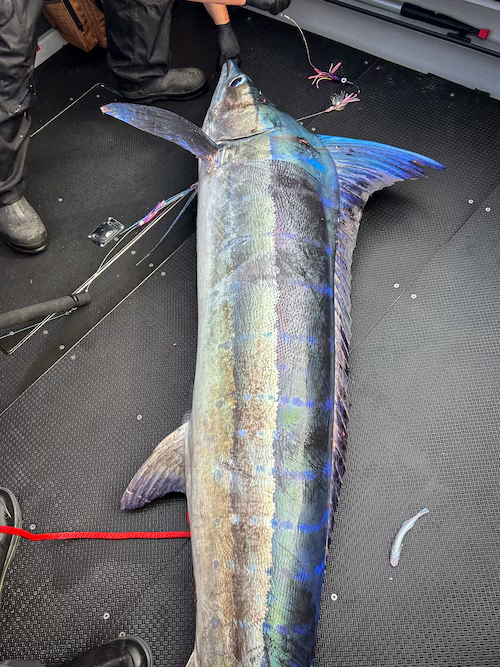
Albacore tuna are the primary pelagic fish that make it this far north. Our waters are generally too cool for other fish. But on August 30, 2025, a family fishing 50 miles west of Garibaldi, Oregon caught a 160lb, 9 foot striped marlin! Striped marlin have been caught in the Pacific Northwest before – a 104lb fish was landed 30 miles out of Westport, WA in September 1997, and a 134lb fish was caught in 2005, once again out of Westport. However, marlin are usually resigned to the waters of southern California and Mexico. It is very rare to see them this far north.
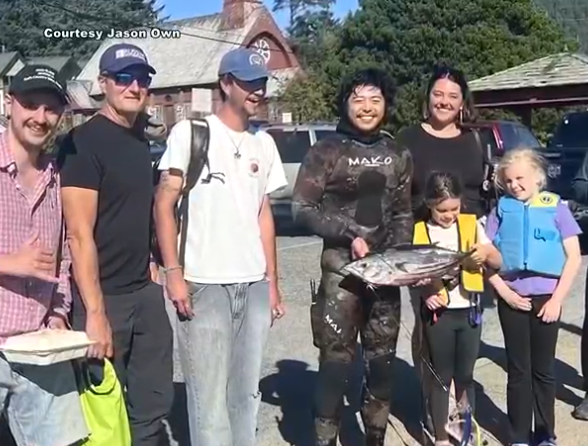
If that wasn’t enough, there were multiple tuna catches out of Sitka, Alaska last week. It is remarkable to see tuna traveling that far north. While the biggest catches were offshore, one man caught a skipjack tuna inside Sitka Harbor while spearfishing (diving and using a spear gun to catch fish).
When plotting where to fish, tuna fishers use high-resolution satellite imagery to track sea-surface-temperatures (SST) and chlorophyll concentrations. Chlorophyll is a measure of primary productivity (i.e. phytoplankton concentrations), so higher chlorophyll concentrations generally correlate to green/brown, nutrient-rich water with higher concentrations of marine life. Pelagic fish have exceptional eyesight and are sight-feeders, so they prefer to swim in warmer (ideally >= 62 degrees), clearer, blue water that is adjacent to nutrient-rich, upwelled water off the coast. Looking at the high-resolution chlorophyll and SST charts from late August, you can see the sharp temperature and chlorophyll gradients offshore. This is likely where tuna fishers were concentrating their efforts. This is around ~125o west (40-50 miles offshore) for many recreational and charter boats fishing off the Washington/Oregon Coasts. Commercial fisherman tend to go further offshore (~126o west), where waters are even warmer/bluer yet still have some sharp breaks with cooler and more nutrient-rich coastal waters.
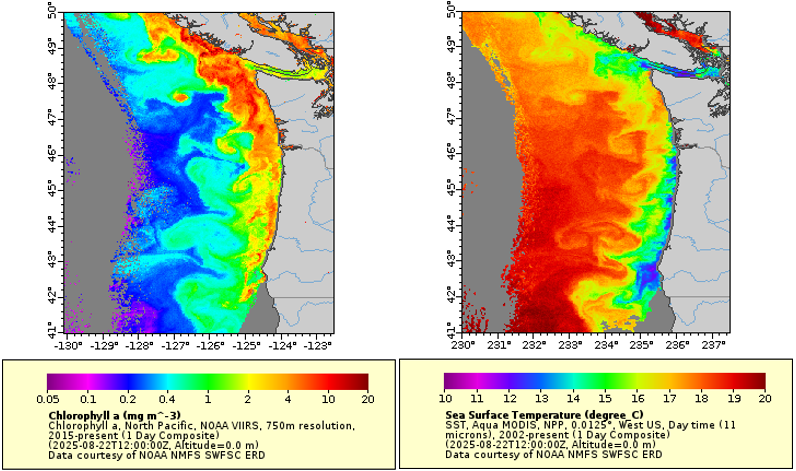
Credit: NOAA CoastWatch, retrieved from gridDAP data catalog
Unsurprisingly, the sea-surface-temperatures over the North Pacific are a good 2-3 degrees C above average. This is encouraging pelagic fish like marlin and tuna to travel further north than average.
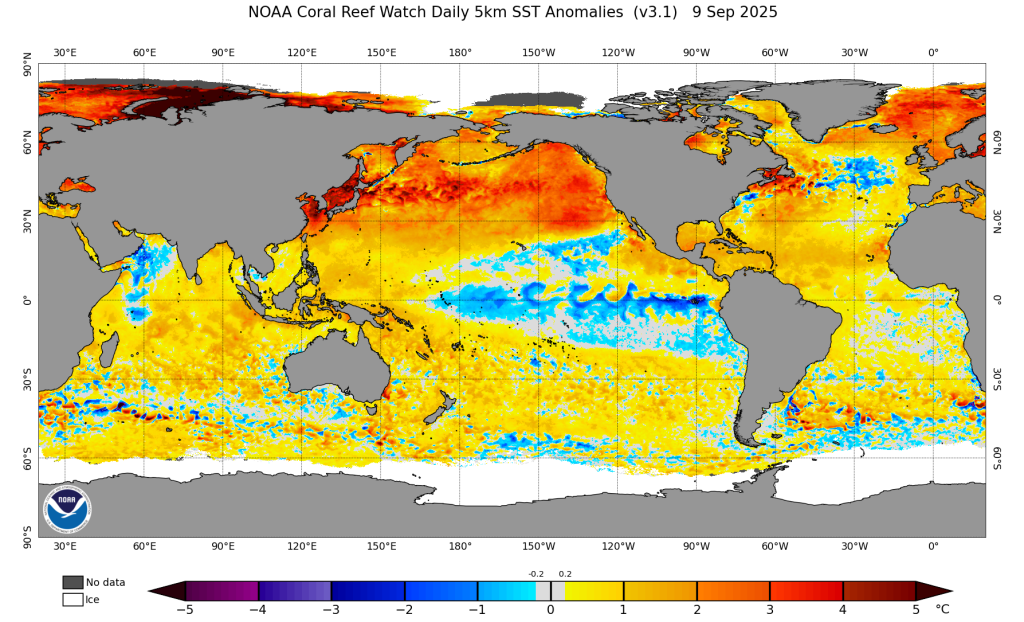
The image above also shows a budding La Nina in the tropical Pacific. Indeed, the Climate Prediction Center just issued a La Niña Watch today, stating that “a transition from ENSO-neutral to La Niña is likely in the next couple of months, with a 71% chance of La Niña during October – December 2025.” I’ll have more on this in a blog tomorrow.