Late last week, the Trump Administration issued two massive cuts to NOAA (National Oceanic and Atmospheric Administration) personnel. As I am not a NOAA employee, I do not know the exact details, but from what I’ve heard, it sounds like these cuts occurred in two “rounds.” According to Craig McClean, a former NOAA chief scientist, 500 employees were fired with the first round of cuts and 800 were fired with the second round. Like we’ve seen with the mass layoffs across other agencies, probationary employees were targeted first.
NOAA is part of the U.S. Department of Commerce and covers six agencies: the NOAA Marine & Aviation Operations (OMAO), the NOAA Marine Fisheries Service (NMFS), the National Ocean Service (NOS), the Office of Oceanic and Atmospheric Research (OAR), the National Environmental Satellite, Data, and Information Service (NESDIS), and the National Weather Service (NWS). All agencies were hard-hit, but I’m most familiar with the National Weather Service so I will focus on the impacts here.
The National Weather Service is dedicated to producing weather, hydrologic, and short-to-medium term seasonal forecasts and warnings for the United States and its territories. The organization now known as the National Weather Service was initially established on February 9, 1870 as “The Division of Telegrams and Reports for the Benefit of Commerce,” was renamed the “Weather Bureau” and transferred to the Department of Agriculture in 1890, was moved to the Department of Commerce in 1940, and was officially renamed as the “National Weather Service” in 1970 under “Reorganization Plan No. 4,” which established NOAA and was signed by Richard Nixon. As a division of the Department of Commerce, the National Weather Service is organized within the portion of the federal government responsible for fostering domestic economic development and resilience. The mission statement of the National Weather Service summarizes it best: “To provide weather, water, and climate data, forecasts, and warnings for the protection of life and property and enhancement of the national economy.”
Weather and climate-related disasters are increasing in severity and frequency due to the increasing value of assets at risk from these storms and – in many cases – increasing severity of the storms themselves. The National Weather Service provides many benefits, but it truly excels in communicating the hazards of severe weather with emergency managers, private enterprise, and the public at large. As an example, look at some of the Los Angeles’ National Weather Service’s social media posts ahead of the tragic Southern California fires this past January. As tragic as the event was, can you imagine what it would have looked like without the National Weather Service and how many more people could have died?
HEADS UP!!! A LIFE-THREATENING, DESTRUCTIVE, Widespread Windstorm is expected Tue afternoon-Weds morning across much of Ventura/LA Co. Areas not typically windy will be impacted. See graphic for areas of greatest concern. Stay indoors, away from windows, expect poweroutages. #LA pic.twitter.com/yl83LxeMEc
— NWS Los Angeles (@NWSLosAngeles) January 6, 2025
Extreme fire danger will continue thru Wed. PDS Red Flag Warnings are for the extreme of the extreme fire weather scenarios. In other words, this setup is about as bad as it gets. Stay aware of your surroundings. Be prepared to evacuate. Avoid anything that can spark a fire.#cawx pic.twitter.com/JedMNHvygB
— NWS Los Angeles (@NWSLosAngeles) January 13, 2025
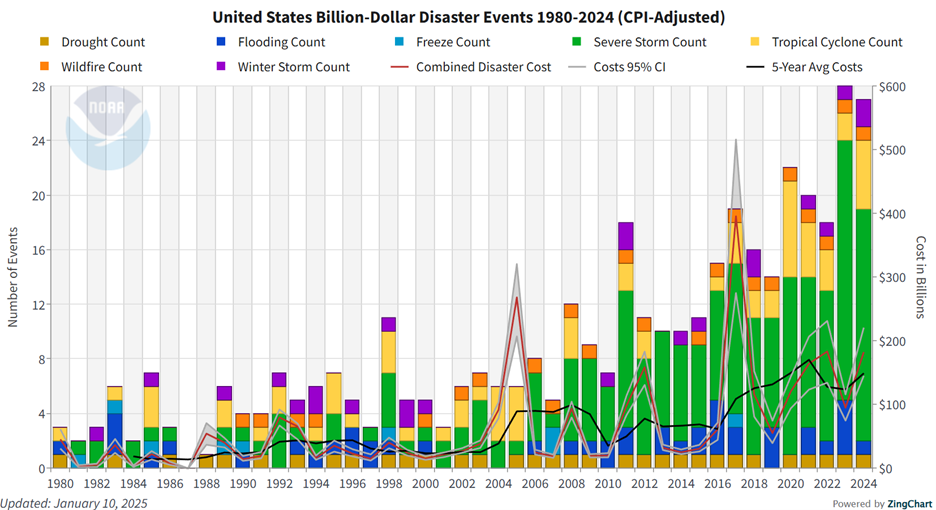
NOAA creates a product that they call the “billion-dollar-disasters” database. This database shows all of the events that have caused over a billion dollars of damage to the United States since 1980. Through the end of 2024, there are 403 of these events and they show a clear increasing trend with time. Five of the six costliest years have occurred in the last decade (the other was 2005, which featured Hurricanes Katrina, Rita, and Wilma). Extreme weather events now routinely cost us 100-200 billion dollars per year, and with the January 2025 Southern California Fires potentially costing up to $250 billion alone, there is a high chance that 2025 could be the most expensive year yet.
NOAA’s entire budget is approximately 6 billion dollars a year. The National Weather Service gets a little over a billion dollars each year. With extreme weather having more and more of an impact on society, NOAA needs more resources and funding. This isn’t to say that there are inefficiencies in NOAA and the National Weather Service… there are. But this administration is firing the new generation of scientists who are best suited to make those changes. Fewer NOAA employees means fewer heads available to communicate the hazards of severe weather to the public. It is a foolish decision for our domestic prosperity and it needs to be reversed.
If you feel this is as poor of a decision as I do, I encourage you to call or write to your local representatives and tell them that these cuts to NOAA undermine our ability to prepare for severe weather events. A sample letter could look like the following:
[Your Name]
[Your Address]
[City, State, ZIP Code]
[Email Address]
[Date]
The Honorable [Representative’s Name]
[Office Address]
[City, State, ZIP Code]
Subject: Opposition to Personnel Cuts to NOAA
Dear Representative [Last Name],
I am writing to express my strong opposition to the recent personnel cuts at NOAA initiated by the Trump Administration. NOAA and the National Weather Service provide critical services to safeguard our country against the threats posed by severe weather, and these cuts undermine their ability to forecast and communicate these hazards to the public. Extreme weather events cost our country hundreds of billions of dollars per year and these events are increasing in frequency and intensity. NOAA only has a budget of 6 billion dollars and provides a very high return on investment by helping us prepare for and mitigate the impacts of these events
Protecting NOAA is not a partisan issue – it is a matter of public safety and national security. Thank you for your attention to these cuts and please contact me if you have any further concerns.
Sincerely,
[Your Name]
Thank you Charlie! I will write to my senators and congressman, although I am sure they are already doing what they can (as Dems) to get these insane cuts restored.