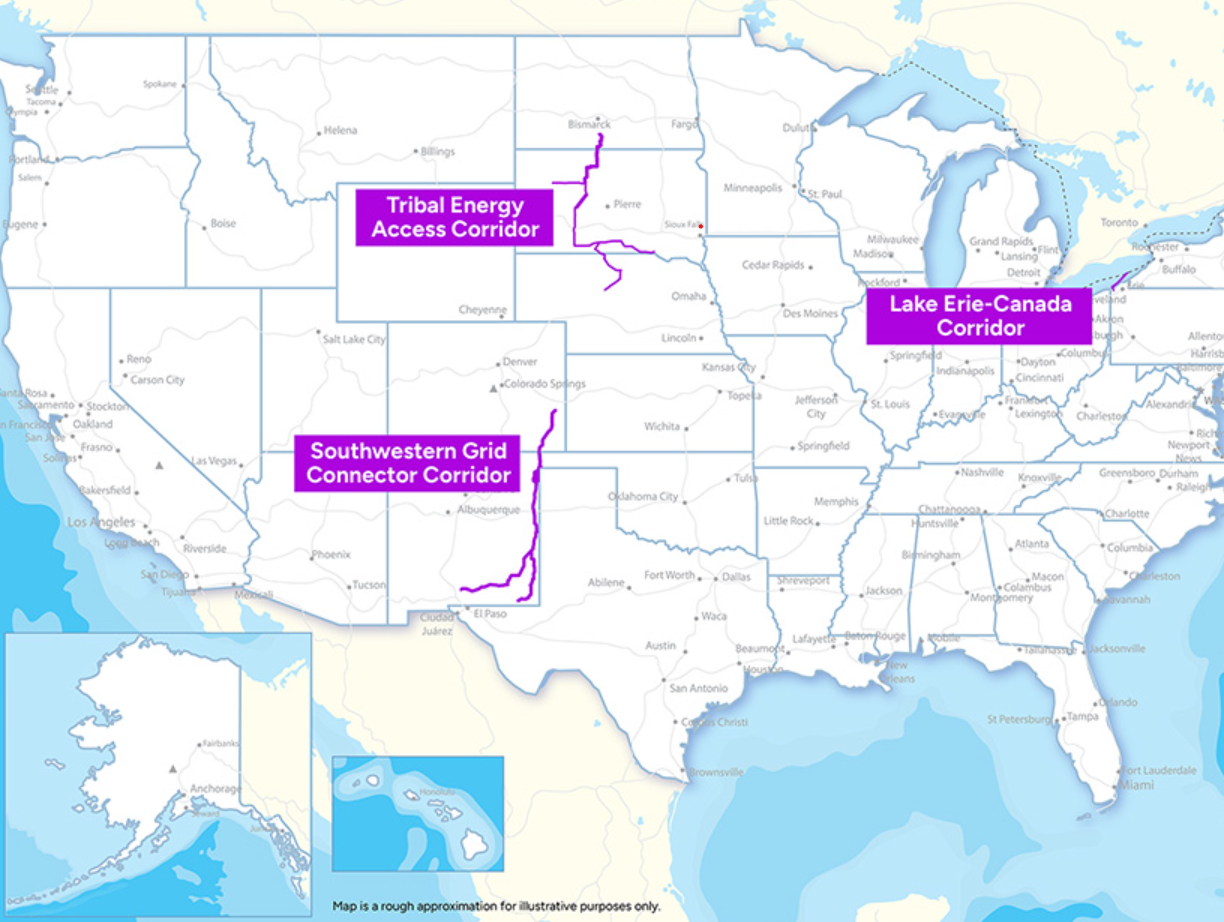
On August 12, Secretary of Energy Chris Wright announced that the Department of Energy would not move forward with designating 3 “National Interest Electric Transmission Corridors” that were identified by the Biden-era DOE in December 2024. Wright cited “public feedback and stakeholder input” as being the reasons for cancelling the corridor designations and claimed that “transmission policy must serve the American people—not special interests or a climate-alarmist agenda that drives up costs, worsens reliability, and disregards the concerns of local communities.” The full press release is here.
I was disheartened to hear of this news because I believe that the country desperately needs more interregional transmission to support the unprecedented demand growth we are now seeing due to data centers and other so-called “large loads.” Unfortunately, transmission has become politicized due to the clear benefit it provides in connecting wind/solar generation to load centers. Critics of renewable energy say that wind and solar cannot provide power when the wind isn’t blowing or the sun isn’t shining, but the more wind/solar generators and weather regimes you can interconnect with high voltage transmission, the more opportunities you have to connect resources that are producing to the demand centers that need power. For example, daily load and solar profiles on the East Coast are 3 hours ahead of the West Coast, different parts of the country have different diurnal wind cycles, some regions see their peak in the winter while others see their peak demand in the summer, and throughout the year, individual weather features such as fronts, low and high pressure systems, and large-scale undulations in the jet stream result in diverse but correlated meteorological conditions across time and space. Interregional transmission can provide economic and reliability benefits by increasing the diversity of weather regimes and wind/solar resource mixes across interconnected regions.
But even though interregional transmission has a clear synergy with wind and solar generation, it is resource agnostic. All it does is help move power from where it is generated to where it is needed. A well-known interregional transmission line in the Western U.S. is the Pacific HVDC intertie from Celilo, Oregon (near The Dalles Dam on the Columbia River) to Sylmar, California (a neighborhood in the northern Los Angeles metro area). Construction began in 1965 and was completed in 1970, and today, it provides over 3 GW of capacity and allows the Pacific Northwest to sell cheap hydroelectricity into expensive Southern California markets, providing economic benefits to both regions. In late 2024, I wrote a post (link here) about the North Plains Connector: a 3 GW HVDC line connecting a 1.5 GW coal plant and extensive transmission system at Colstrip Montana to MISO and SPP in the Eastern Interconnection.
Interregional transmission is also critical for connecting resources to the grid, regardless of type. The proposed, 1,475 MW Bay Shore – Lallendorf natural gas plant in Lucas, County, Ohio is a good example. It was fast-tracked for interconnection through PJM’s Reliability Resource Initiative (RRI), the special fast-track process intended to bring resources identified as significantly improving grid reliability quickly. However, when PJM completed its Transition Cycle 2 Phase 1 interconnection study, it found that the total interconnection costs were nearly 1.3 billion, with approximately 1.26 billion for transmission upgrades throughout the PJM network and only 41 million for upgrades at the plant’s point of interconnection. Due to these astronomical costs, the project withdrew from the interconnection queue
This is politically relevant because representative Troy Balderson (R-OH) introduced the GRID Power Act in 2025, which fast-tracked processes for connecting thermal generation to the power grid and was passed by the House of Representatives. But the fast-track process did not bring the plant online more quickly; it only exposed how constrained the transmission grid is and how massive investments are needed to bring new generation online.
But despite the need for regional and interregional transmission, large transmission projects can still be controversial. Transmission lines are unsightly and people understandably do not want them near their property. There was a story about a transmission line being rerouted due to it going over the grave site of “Dobby the House Elf,” – I thought it was straight out of The Onion, but it was actually true!

Rob Gramlich of Grid Strategies, a Washington DC-based consultancy firm focusing on the electric power industry, has referred to the barriers to transmission investment as the three “Ps”: Planning, Permitting, and Paying. Planning is fragmented and occurs at the state or RTO level, and permitting is handled at the state level, making interregional transmission in particular very difficult to build as any state in the path of the transmission line can deny a permit. “Paying” is potentially the largest obstacle of all; the prevailing policy is that the beneficiaries pay through the “cost causation principle,” but in reality, determining who benefits, how much they benefit, and how much they should pay is a complex and contentious process.
In this post, I’ll focus specifically on NIETCs: what they are, why they’ve failed to build interregional transmission in the past, and potential solutions/alternatives going forward.
NIETC Background
National Interest Electric Transmission Corridors are geographic areas designated by the Department of Energy as being national priorities for transmission development due to their ability to significantly relieve transmission constraints and congestion. Importantly, NIETC designations come with “federal backstop authority,” meaning that the Federal Energy Regulatory Commission (FERC) can issue a permit if a project in the corridor fails through the traditional permitting process, where states issue the permits. NIETCs were designed to address the difficulties in permitting transmission lines, but did not address the “planning” or “paying.” They were first established by the Energy Policy Act (EPAct) of 2005, a landmark bill that substantially reworked portions of the Federal Power Act. NIETCs are described in section 216 of the Federal Power Act.
NIETCs and federal backstop authority were controversial from the beginning. People objected to the ability of the federal government to “override” a decision handled by the states. And understandably so! Imagine if you were a farm owner or rancher and you were concerned about a transmission line coming through your land, so you went to your state representatives, told them your concerns, and they denied a permit for the transmission line. But then all of a sudden, the federal government invents some new rule that allows them to overrule the state’s decision and build it anyway. How would you feel – to spend all that time and effort in trying to prevent something that could significantly impact your property values and quality of life, and succeeding, only to have it all be for naught?
In August 2006, the DOE issued its first National Electric Transmission Congestion Study to identify potential NIETCs, and the first two NIETCs were formally designated in October 2007. These were the “Mid-Atlantic Area National Interest Electric Transmission Corridor” and the “Southwest Area National Interest Electric Transmission Corridor.” The designations were appealed by states and environmental groups, and in 2011, both NIETCs were vacated in the court case California Wilderness Coalition v. DOE, which found that the DOE failed to properly consult with the states within the transmission corridor and found issues with NEPA (National Environmental Policy Act) compliance. NIETCs were pretty much abandoned until 2021, when the Infrastructure Investment and Jobs Act (aka “Bipartisan Infrastructure Law”) reworked section 216 of the FPA and revised the NIETC/federal backstop framework. 10 corridors were identified in May 2024, and by December 2024, three moved to “Phase 3” of the NIETC designation process. The recent decision by the Trump administration cancels these potential NIETCs, preventing them from moving to “Phase 4” where the NIETC designation becomes legally binding. As such, the only corridors that have officially reached NIETC designation status were the original two in 2007, and both of those were blocked by the courts.
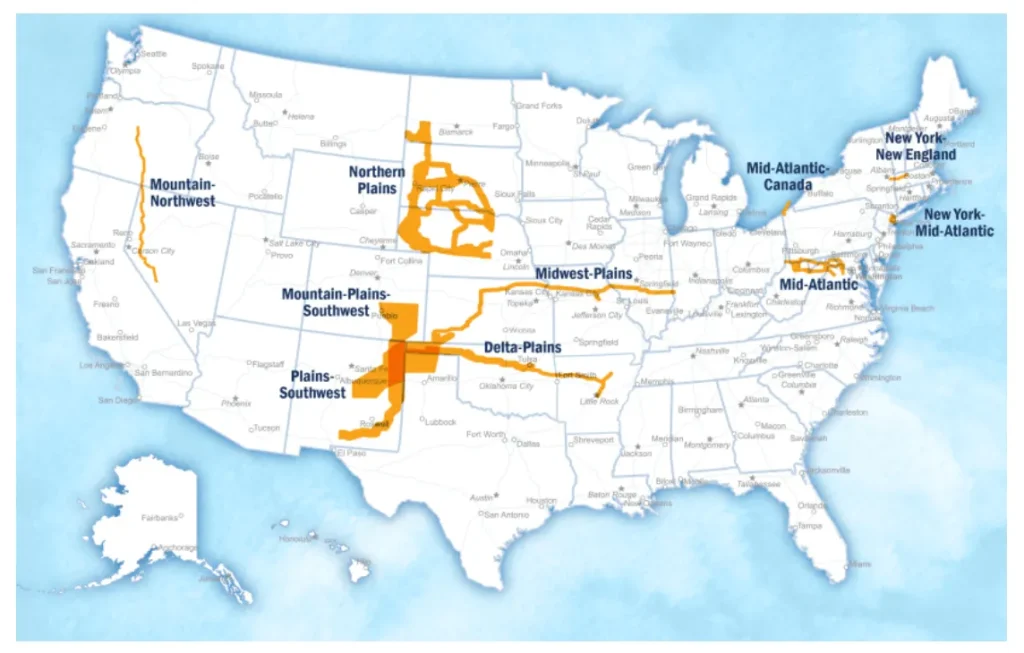
Credit: Department of Energy, retrieved from utilitydive.com
Why NIETCs Have Proven Ineffective
Transmission siting authority has historically rested primarily with the states through which a transmission line passes. This is largely a consequence of how the utility industry developed. The U.S. was electrified in a piecewise fashion, with individual utilities developing generation, distribution, and transmission to serve customers. Before the New Deal legislation of the 1930s (which significantly invested in hydropower & high-voltage transmission via Bonneville Power Administration and the Tennessee Valley Authority, and connected rural America to the grid via the Rural Electrification Administration and rural electric cooperatives), most utilities were private or municipal entities. Though the grid has necessarily become much more interconnected over time, our permitting processes have not kept up with this need. As such, our grid is still highly fragmented and interregional transmission takes much longer to build than it would if planning, permitting, and cost allocation (“paying”) were all handled at the federal level.
NIETCs were created to address this gap, but they have been ineffective for several reasons. First, NIETC designations have proven not to be robust to legal and political challenges. As mentioned, the original NIETC designations were vacated by the courts in California Wilderness Coalition v. DOE, while the candidate NIETCs advanced by the Biden administration were subsequently terminated by the Trump administration. Second, the process for identifying NIETCs and implementing federal backstop authority is slow and layered. Per the original 2005 amendment to the Federal Power Act, DOE must first designate a NIETC, and federal backstop authority can be used if the states ‘withheld approval for more than a year’ to a developer who sought a permit to build in that NIETC. The Bipartisan Infrastructure Law strengthened federal backstop authority by allowing developers to seek a permit if a state explicitly ‘denied’ a permit, but the process was still cumbersome in other ways. For example, FERC is the ultimate authority responsible for issuing the federal permit if federal backstop authority would ever be used, not the DOE, and involving multiple agencies creates additional inefficiencies and friction. Third, developers prefer to liaise directly with landowners and states to receive permits; it is the method of least resistance for building a transmission line. Additionally, there may be optics issues with a developer relying on federal backstop authority to “ram a project through” when states have denied permits. In fact, the DOE cited the “lack of expressed developer interest in seeking FERC backstop siting authority” when cancelling the candidate NIETCs (link).
Pathways To Build Interregional Transmission
My personal stance is that because the electric system is a machine spanning multiple states, it would benefit from federal mechanisms for planning, permitting, and paying to yield the greatest benefit at lowest cost to consumers. Unfortunately, our current processes for permitting transmission serve as a bottleneck for AI-driven economic development, as we simply don’t have the transmission capacity to interconnect large generation and demand centers to the grid. In my opinion, the ideal policy would be to have permitting handled at the federal level, like it is with natural gas pipelines. However, the struggle of NIETCs to get designated, much less built, since they were first incorporated into the Federal Power Act in 2005 is a testament to the difficulty of changing the current permitting mechanisms.
Thankfully, there has been some bipartisan work in Congress that has aimed at strengthening federal permitting mechanisms. The Energy Permitting Reform Act of 2024 (EPRA) was led by Senators Joe Manchin (I-WV) and John Barrasso (R-WY) and would have streamlined permitting for energy generation, extraction, and transmission. It was approved by the Senate Energy and Natural Resources Committee by a vote of 15-4, but it never passed the full Senate or House. Though it was led by senators from two major coal-producing states, it was a far-reaching bill and would have removed red tape for oil/gas exploration and generation/transmission permitting. For transmission permitting, it would have eliminated DOE’s ability to designate NIETCs, but it would have strengthened the federal permitting process by allowing FERC to exercise federal backstop authority for transmission facilities that were ‘in the national interest.’ This change would have effectively condensed the process for issuing federal backstop authority from two federal agencies (DOE and FERC) to just FERC by eliminating the NIETC requirement. It also would have required neighboring planning regions to conduct joint interregional transmission planning, going significantly beyond FERC Orders 1000 and 1920 which are primarily aimed at regional transmission planning and do not require joint interregional transmission plans.
In March 2026, a discussion draft led by Senator John Hickenlooper expanding upon the transmission permitting section of the 2024 EPRA was published. The largest change in this draft relative to EPRA is that it provides a much stronger pathway for federal permitting; FERC can issue a permit if it finds the project is “necessary in the national interest” instead of waiting for the states to approve within a year and then issuing a federal backstop permit if the project is not approved. In this sense, the permitting is no longer federal “backstop” permitting, it is federal “primary” permitting. The draft also broadly adapts EPRA to many of the provisions in FERC Order 1920, and it adds provisions for cost allocation for large loads, faster generator interconnection, grid-enhancing technologies (GETs) and reconductoring, merchant transmission compensation, and extreme weather resilience/reliability. The contributing senators on the draft were either Democratic (Hickenlooper/Padilla/Gallego/Cortez Masto) or Independent (King), so a more bipartisan version may be less sweeping, particularly with respect to federal permitting (my impression from following recent activities on the Hill is that most Republicans favor keeping the state process in place, as shown by the congressional testimony linked at the end of this blog). At the same time, there is broad bipartisan understanding that more interregional transmission is required. A powerful motivator is that China is “eating our lunch” with respect to transmission development, and if the U.S. wants to remain competitive with China into the 21st century, it is critical to develop robust electric generation and transmission infrastructure. If AI leadership is as much of a national security issue as the U.S. government claims, then building the transmission and generation to support data center growth is as well.
To end: it’s important to note that even those who are opposed to the use of federal backstop authority recognize the necessity of interregional transmission, but you have to parse their words to see how much they actually prioritize building this transmission. Former FERC Chair Mark Christie, who was nominated to FERC by Trump in 2020 and designated as FERC chair by Trump in 2025, has stated that “we need more interregional transmission” but that the interregional transmission requirements should not be federally mandated; they should instead be evaluated on a case-by-case basis. My issue with this contention is that the incentives for interregional transmission are pretty weak under our current framework. Investor-owned utilities are generally limited to a regulated return on equity (ROE) on approved transmission investment, so there may be little additional financial reward for identifying the optimal transmission project (in terms of the highest benefit to society per dollar invested) if that project is substantially more difficult and risky to permit and allocate costs for. If that type of investment is not incentivized, there is no reason for the utility to take on uncompensated permitting risk and cost-allocation complexity for an interregional project. So, whenever somebody says “interregional transmission is important” but qualifies that statement, ask them what they would suggest to make interregional transmission cheaper and faster to build.
Finally, below are some relevant links. If you have the time, the congressional hearing is fantastic for learning the current political leanings of Democrats vs. Republicans for transmission permitting reform and testimony from experts with a variety of perspectives.
- The 2024 Energy Permitting Reform Act: https://www.congress.gov/bill/118th-congress/senate-bill/4753/text
- The 2026 Discussion Draft (led by Sen. Hickenlooper): https://www.padilla.senate.gov/wp-content/uploads/PAT262402.pdf
- “Wires, Rates, and States: Permitting Transmission for Reliable and Affordable Power” (5/13/2026): congressional testimony on transmission permitting before House Committee on Energy & Commerce (includes Mark Christie, Rob Gramlich, Tony Clark, Randy Howard, Clay Rikard, Michael Skelly): see below