In my previous blog, I talked about the two components of a reliable energy system: energy security and energy adequacy, and I gave the 2003 Northeast Blackout as an example of a security failure and the February 2021 Texas Blackout as an example of an adequacy failure (though the 2021 event also had security failures). I also wrote about the relationship between energy adequacy and energy prices via the generation ‘supply stack’ and locational marginal pricing (LMP).
While energy adequacy refers to having enough energy to meet real-time demand & losses, resource adequacy is used for planning purposes and refers to the ability of supply and demand-side resources to provide enough capacity (i.e. – available power) to meet estimated peak future demand & losses, plus reserve requirements. I also described some commonly-used metrics for resource adequacy: the Loss-of-Load-Expectation (LOLE), Expected Unserved Energy (EUE), and Effective Load Carrying Capacity (ELCC), and how these inform the Planning Reserve Margin (PRM) – the extra capacity utilities are required to hold to ensure demand plus reserve requirements are met. Finally, I summarized how our changing electricity system, with far more wind/solar, batteries, interregional transmission, and demand response may require us to fundamentally rethink how we model resource adequacy, as the current methodology is well-suited for thermal-dominant systems with little interregional transmission but breaks down with high renewables, high demand response, and much more transmission.
In this blog, I’ll give a brief literature review of how resource adequacy modeling has evolved from deterministic “N-1” Planning in the 30s, to the probabilistic methods developed by Calabrese in the 40s/50s, and then refined by Billinton during the latter half of the 20th century. Billinton’s work represents the benchmark for how resource adequacy is modeled and quantified in industry today. Finally, I’ll summarize the paradigm shifts in resource adequacy modeling that academic literature has proposed in the last few years as we transition from a system predominantly composed of dispatchable, thermal generation to one with distributed, renewable generation connected by long-distance transmission and integrated with battery storage.
Early 20th Century: Deterministic Modeling and Formation of Power Pools
Before the 1940s, resource adequacy modeling was primarily done in a deterministic, heuristic fashion. The general industry planning guideline was to ensure there was enough online capacity to meet all load plus the loss of the single largest generator [1]. This is closely related to the concept of an “N-1 contingency” in short-term power system reliability, which states that the power system must maintain reliability if any single component on the grid fails. While N-1 contingency analysis is still used throughout the power system today to study the reliability of the grid to short-term disturbances, the key point is that it was used as a benchmark for resource planning in the early 20th century. Utilities built enough resources to meet future load projections, plus a somewhat arbitrary “margin” to ensure the system had enough generation to serve load in the event of the loss of the largest generator.
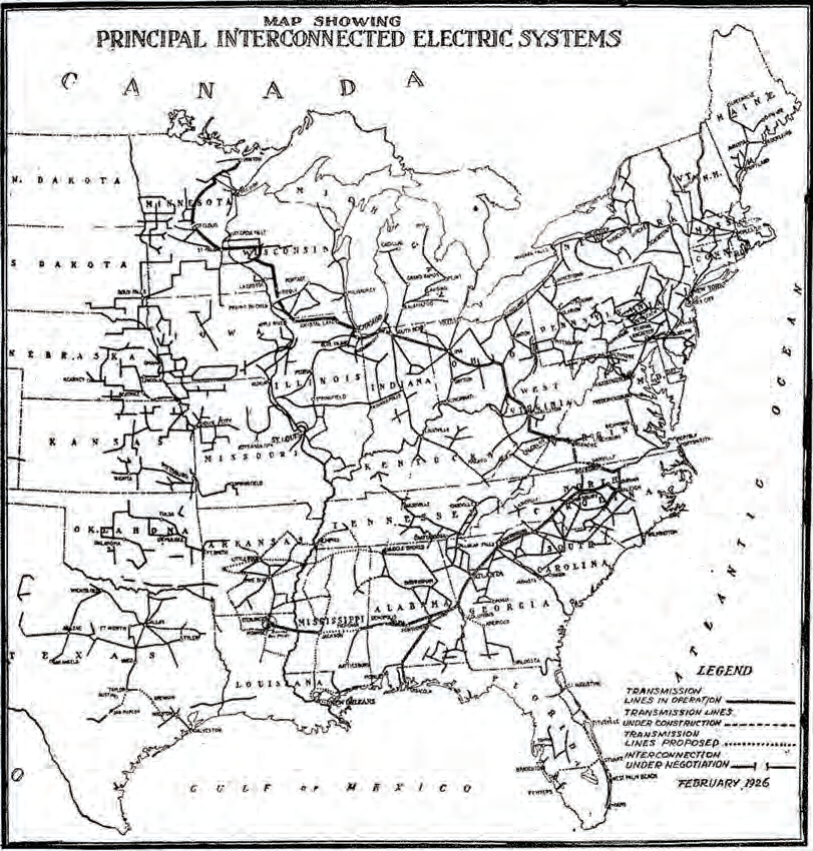
Image Credit: Southwest Power Pool [3]
Utilities that were interconnected via high voltage transmission lines also formed ‘reserve sharing agreements,’ which allowed utilities to share reserves if any single utility did not have enough generation to meet load. Some reserve sharing agreements were between individual utilities, while others were separate entities comprised of many member utilities known as ‘power pools.’ The Pennsylvania-New Jersey Interconnection (now known as PJM for Pennsylvania, (New) Jersey, and Maryland) was the world’s first power pool and was formed in 1927 between three member utilities [2]. In December 1941, the Southwest Power Pool (SPP), so-named because it covered the southwest portion of the Eastern Interconnection, was formed shortly after the bombing of Pearl Harbor so that utilities could share resources to industrial facilities that supported the war effort [3]. Overall, these reserve sharing agreements have been immensely successful and PJM, SPP, and many organizations that originally started as power pools are now full-fledged Regional Transmission Organizations (RTOs) that operate the electric grid, administer electricity markets, and develop long-term transmission infrastructure plans.
40s-50s: Probabilistic Resource Adequacy Modeling Begins
There was a movement towards probabilistic resource adequacy analyses as early as the 1930s. For example, while [1] speaks solely of a deterministic N-1 energy reserve margin requirement, [4] (written by the same author, 8 years later) acknowledges the need for a “thorough study of equipment performance, load variations, and outage probabilities” that achieve a “better coordinated distribution of spare capacity from the generator to the consumer.” This shift in thinking recognizes that energy adequacy cannot be guaranteed at all times due to the potential for outages, changes in weather/load, etc., so it shifts from framing resource adequacy as a deterministic issue – where a system should be built to withstand the loss of the largest generator – to a probabilistic one – where a system should be built to a desired probability of reliable operation, balancing reliability metrics with investment costs. Statistical methods for calculating resource adequacy in a probabilistic way were first formulated in the 1934 papers by Smith Jr. [5], [6], [7], but a much more robust framework was developed in 1947 by Guiseppe Calabrese [8]. Calabrese uses the convolution method to create a total available generator capacity distribution based on forced generator outage rates, and he compared these generator capacity distributions to load profiles to determine the expected count of the number of days in which daily maximum load would exceed available capacity, specifying this as the “probability of loss of load.”

Credit: Calabrese, 1947 [8]
Late 20th Century: Probabilistic Resource Adequacy Modeling Matures
Calabrese’s work served as a foundational resource for improvements in resource adequacy modeling in the subsequent decades, particularly through the work of Roy Billinton. Billinton extended Calabrese’s convolution method to Monte Carlo methods that are more scalable to large systems and, unlike convolution methods, do not assume independence between variables, which is key for modeling correlations between demand, forced outages, and wind/solar generation. Billinton and Allan also played a key role in defining and formalizing LOLE, LOLP, EENS (aka, EUE), ELCC, and other common resource adequacy “metrics.” Their 1983 book “Reliability Evaluation of Power Systems” is a seminal work and constitutes the foundation for how resource adequacy is modeled today in industry. Allan and Billinton’s IEEE paper “Probabilisitic Assessment of Power Systems” provides a concise treatment and is freely available here.
21st Century: New Resource Adequacy Paradigms for High-Renewable Power Systems
Resource adequacy work has continued in the subsequent decades, but there has been a particular resurgence in resource adequacy work in the 2020s. We are now undergoing a paradigm shift from a system with predominantly dispatchable generation (like thermal & hydro plants) to one with variable energy resources (VERs) (like wind and solar) and short-duration (4-10 hr) battery storage. This paradigm shift requires a fundamental rethinking of how we quantify resource adequacy due the increasing weather-dependence of generation/load and the duration of periods of stressful system conditions due to batteries only being able to dispatch over the short term. Finally, much of the new load coming online is in the form of data centers and bitcoin miners, and these loads (particularly bitcoin miners) can be extremely price-sensitive and have a different daily/seasonal profile than residential/commercial loads, yet they also have the potential to provide valuable services to the grid in the form of instantaneous demand response.
One of the main shifts is rethinking resource adequacy in terms of energy adequacy and not installed capacity, because wind and solar are not dispatchable resources. The ELCC framework developed by Billinton and others can estimate the capacity contribution of wind and solar, but it is a static value and becomes increasingly untenable when wind and solar make up a larger percentage of the grid. Because weather patterns follow certain, predictable laws (e.g. a polar vortex in the winter may be flanked by ridging and warmer weather to its west and east) a new resource adequacy paradigm that captures these relationships by explicitly modeling weather patterns can yield the benefits of resource diversity and optimize investments to increase resource adequacy at lower cost. There has been much research in this space. Juan Carvallo and others in the Electricity Markets & Policy group at Lawrence Berkeley National Lab summarize current resource adequacy practices and identify emerging challenges and potential solutions [9]. Derek Stenclik and the Energy Systems Integration Group emphasize the importance of interregional transmission to increase resilience to energy adequacy events, the need for an interregional, ‘energy margin’ dataset to quantify energy adequacy, and methods for deterministic “stress testing” of portfolios during high-risk weather patterns [10].
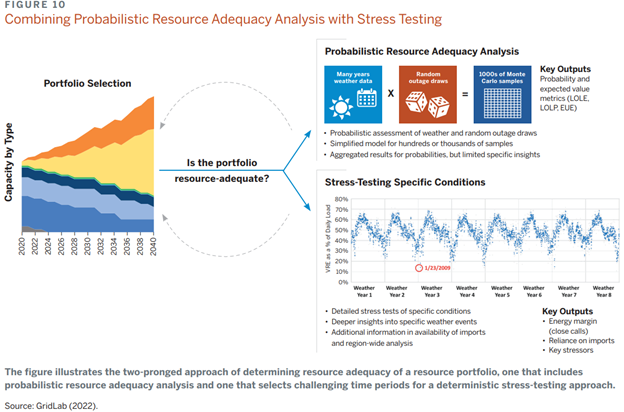
Graphic retrieved from Energy Systems Integration Group (ESIG) report on resource adequacy
Recent papers by NREL researchers such as Trieu Mai, Patrick Brown, and Gord Stephen propose new paradigms for resource adequacy modeling that iterate through multiyear weather datasets, identify “stress periods” within these datasets through resource adequacy software, and optimize for resource adequacy to these stress periods within an expansion planning program by directly modeling wind/solar energy contributions instead of using capacity credits [11], [12], [13], [14]. This would represent a radical shift in how resource adequacy is accounted for in expansion planning models. The graphics below, taken from [12], show a high-level view of the “current” resource adequacy modeling framework used in expansion planning models that relies on capacity credits and planning reserve margin, and NREL’s “proposed” framework that identifies periods of low energy margin from multiple years of weather data, “re-invests” in generation and transmission to ensure resource adequacy during those stress periods, and iterates until the desired resource adequacy threshold is met, eliminating the needs for capacity credit heuristics and seasonal planning reserve margins altogether.
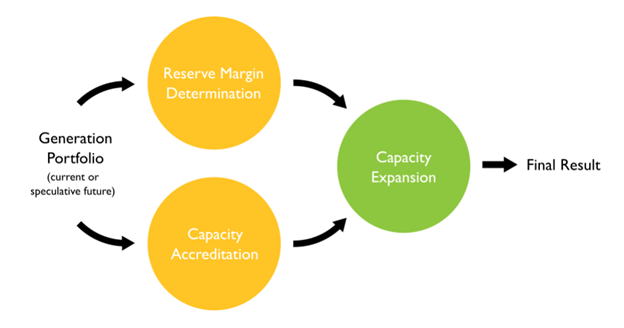
Credit: Kuna et al., 2024 [12]
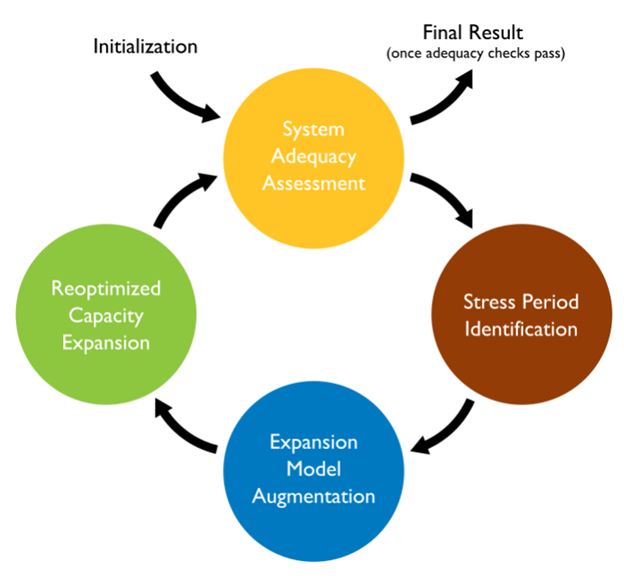
Credit: Kuna et al., 2024 [12]
The bottom line is that as the electricity system has greater shares of time-limited storage (like batteries) and non-dispatchable resources (like wind and solar), resource adequacy modeling must evolve to reflect this new reality. In my opinion, this ‘new paradigm’ of resource adequacy must prioritize explicitly modeling wind/solar generation during periods of system stress and capturing the capacity value provided by transmission.
Resource Adequacy Modeling: Academia vs. Industry
Though there is some exciting academic literature within resource adequacy modeling as summarized above, resource adequacy assessment within industry has been very slow to change, and large-scale changes are not likely for the foreseeable future. This is a consequence of the ‘patchwork’ nature of the utility industry itself. To ensure that no utility is unfairly ‘leaning’ on another utility for resources, power pools must require individual utilities to supply enough generation to meet their maximum load, plus a planning reserve margin. The problem with this “generation-only” approach is that essentially treats each utility as an “island” and completely ignores the benefits provided by diversity in location/resource type that can be utilized with long-distance transmission. The importance of interregional transmission was on full display during the Texas Blackout of February 2021, as Texas is its own electric grid and lacks the ability to import substantial amounts of power from neighboring regions. However, the patchwork nature of the utility industry makes coordinating long-distance transmission projects exceedingly difficult. I believe industry needs to be open to some of the new paradigms proposed by academia, but academia also should understand that there are good reasons why resource adequacy is modeled the way it is in industry and significant policy consequences for implementing new paradigms. But at the end of the day – we all want a cheaper, cleaner, and more reliable power system, and I believe academia and industry can collaborate to achieve that goal.
My next resource adequacy blog will summarize how the current industry practices for resource adequacy modeling, using the Southwest Power Pool as a case study. It should be a fairly lengthy post, so I’m not sure when I’ll get around to it. Until then, expect some shorter weather and science posts – we haven’t had much weather to talk about in Arkansas (besides the unbearable humidity), but the nature here has sure been amazing. I will miss the Ozarks when I head back to Iowa!
Sources
[1] S. M. Dean, “The Fundamental Plan of Power Supply of the Detroit Edison Company,” Trans. Am. Inst. Electr. Eng., vol. 49, no. 2, pp. 597–604, Apr. 1930, doi: 10.1109/T-AIEE.1930.5055542.
[2] “PJM – PJM History.” Accessed: Aug. 01, 2025. [Online]. Available: https://www.pjm.com/about-pjm/who-we-are/pjm-history.aspx
[3] N. Sawyer and L. Dillahunty, “The Power of Relationships: 75 Years of Southwest Power Pool,” Southwest Power Pool, Little Rock, Arkansas, 2016. [Online]. Available: https://www.spp.org/documents/46282/spp-75th-anniversary-online.pdf
[4] R. N. Allan, R. Billinton, A. M. Breipohl, and C. H. Grigg, “Bibliography on the application of probability methods in power system reliability evaluation: 1987-1991,” IEEE Trans. Power Syst., vol. 9, no. 1, pp. 41–49, Feb. 1994, doi: 10.1109/59.317559.
[5] S. A. Smith Jr., “Spare Capacity Fixed by Probabilities of Outage,” Electr. World, vol. 103, no. 6, pp. 222–225, Feb. 1934.
[6] S. A. Smith Jr., “Service Reliability Fixed by Probabilities of Outage,” Electr. World, vol. 103, no. 10, pp. 371–374, Mar. 1934.
[7] S. A. Smith Jr., “Probability Theory and Spare Equipment,” Edison Electr. Inst. Bull., vol. 2, no. 3, pp. 491–498, Mar. 1934.
[8] G. Calabrese, “Generating Reserve Capacity Determined by the Probability Method,” Trans. Am. Inst. Electr. Eng., vol. 66, no. 1, pp. 1439–1450, Jan. 1947, doi: 10.1109/T-AIEE.1947.5059596.
[9] J. Carvallo, N. Zhang, B. Leibowicz, T. Carr, S. Baik, and P. Larsen, “A Guide for Improved Resource Adequacy Assessments in Evolving Power Systems: Institutional and Technical Dimensions,” None, 1987650, ark:/13030/qt4dq364g2, June 2023. doi: 10.2172/1987650.
[10] D. Stenclik, “New Resource Adequacy Criteria for the Energy Transition: Modernizing Reliability Requirements,” NREL/SR–6A40-89334, 2372882, MainId:90113, Mar. 2024. doi: 10.2172/2372882.
[11] T. Mai, P. R. Brown, L. Lavin, S. C. Dhulipala, and J. Kuna, “Incorporating Stressful Grid Conditions for Reliable and Cost-Effective Electricity System Planning,” 2024, SSRN. doi: 10.2139/ssrn.4841668.
[12] J. Kuna, G. Stephen, and T. Mai, “Beyond Capacity Credits: Adaptive Stress Period Planning for Evolving Power Systems,” NREL/TP–6A40-89386, 2368579, MainId:90165, May 2024. doi: 10.2172/2368579.
[13] G. Stephen, “Enhanced Representations of Probabilistic Resource Adequacy Risk in Power System Capacity Expansion Modeling,” Dissertation, University of Washington, Seattle, 2025. [Online]. Available: https://digital.lib.washington.edu/server/api/core/bitstreams/9d0660e0-572f-458a-b27e-46a51064f908/content
[14] P. R. Brown, W. J. Cole, and T. Mai, “An interregional optimization approach for time series aggregation in continent-scale electricity system models,” Energy, vol. 332, p. 135830, June 2025, doi: 10.1016/j.energy.2025.135830.