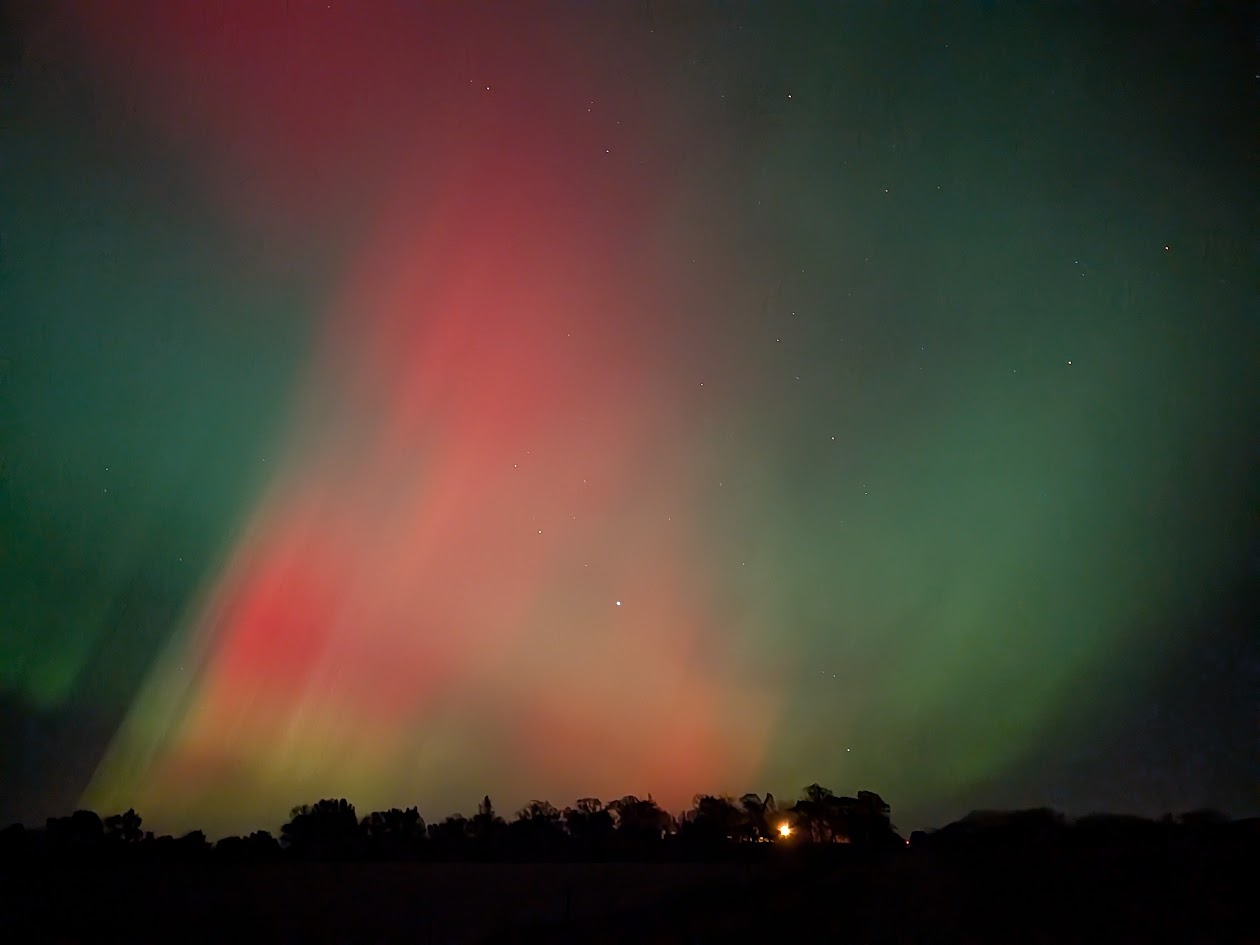
In the pre-dawn hours of Tuesday morning, a massive solar flare erupted over the sun, ejecting a large amount of mass within the sun’s corona out through the solar system. By Tuesday afternoon, this stream of plasma reached Earth, and on Tuesday evening, much of North America was treated to a spectacular aurora. The lights were shockingly bright here in Iowa, and long-exposure cameras captured the aurora as far south as Florida.
A few images of last night's #NorthernLights event from central Florida, across the Indian River from NASA's Kennedy Space Center, near Titusville. What a wild night! pic.twitter.com/I2k4LcoFwD
— Nick Stewart (@NStewWX) November 12, 2025
One of the most striking videos was taken by Dan Brisbois much further north in the Canadian province of Saskatchewan. Look at how quickly the “curtains” move. The purple colors indicate a particularly strong solar storm.
🌌 Northern Lights in real time — nature’s version of a divine light show.
— Dan Brisbois (@Dan_Brisbois) November 12, 2025
No filter, no CGI, just raw magnetic chaos painting the sky.
If you ever get to see it, remember… the universe doesn’t care who you are, but it’ll still put on a show for you.#NorthernLights… pic.twitter.com/d2CYNxxbde
I had never seen an aurora before moving to Iowa, but I have since seen three: one on May 10, 2024 (see blog here), another on October 10, 2024, and then this one on Veteran’s Day 2025. They were all incredible in their own way… the May event had fast-moving curtains like the animation above (though significantly fainter) and no purples, the October event had deep reds, and last night’s event rapidly grew from a relatively faint aurora on the northern horizon to one with thick sheets of green and red, almost like sunbeams shining through a blanket of clouds. I saw all events near Zenorsville, Iowa, a tiny farming community about 20 minutes northeast from Ames.
Below are some of the pictures I took, form earliest to latest. The aurora was a little underwhelming when I arrived at Zenorsville at 10:10 pm, but it began to pick up around 10:25, and from there it became much more dramatic and spanned further south and west. The peak of the action seemed to be around 10:37, with the aforementioned “sheet” of greens and reds filling up the sky. The aurora was still raging around 10:55 pm, after which I began driving back to Ames.
Also, when looking to the east, the aurora encompassed Venus and the constellation Orion. I’ve labeled them in the first pic, see if you can find them in the subsequent pictures. Right click the individual pictures to open an enlarged version in a new tab on your browser.


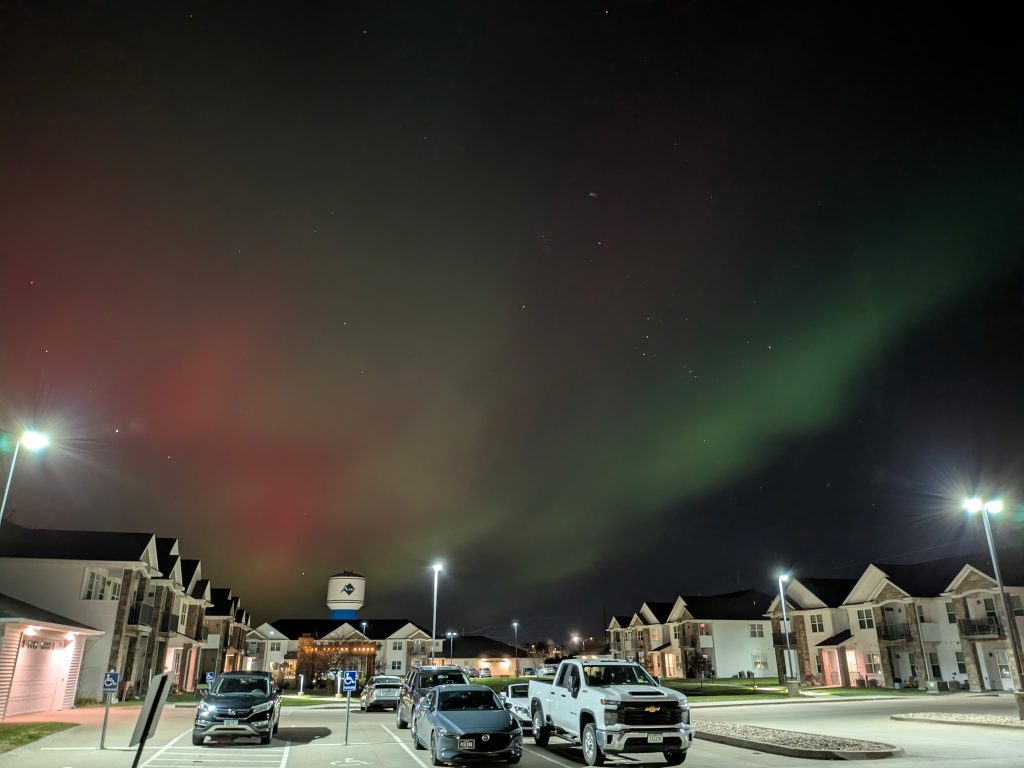
The aurora was even visible from downtown Ames. Check out Tyreek Frazier’s (a Ph.D candidate in atmospheric science) picture from Somerset in Northern Ames. The camera makes the auroras look brighter than they are but multiple people said it was clearly visible all over Ames and Iowa State University with the naked eye.
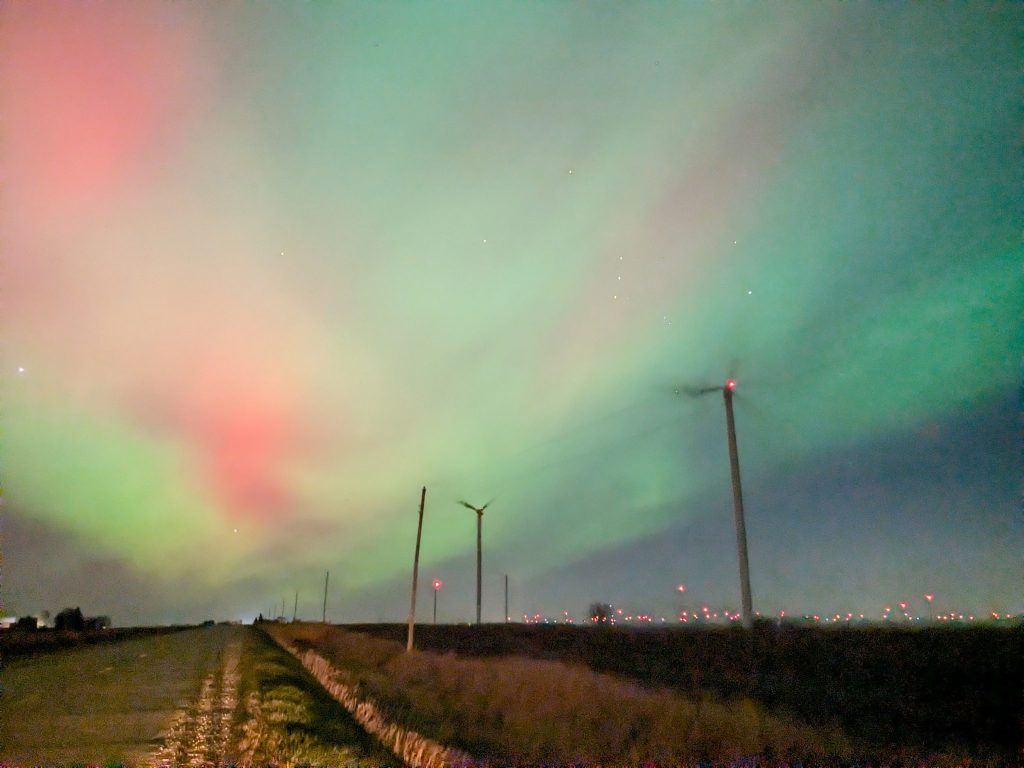
Here is another from Nick Markus, a master’s student in atmospheric science. Very cool pic with the windmills in the foreground!
Like all auroras, it was caused by a coronal mass ejection (CME), which are often (but not always) associated with solar flares. CMEs are ejections of the sun’s mass from the corona into the sun’s heliosphere, the vast, outermost layer of the sun’s atmosphere that contains the solar wind and extends beyond the solar system. There are 5 classes of solar flares (A, B, C, M, and X), measured by the intensity of x-ray radiation discharged from the sun. X-class CMEs are the strongest.
This was an X-class flare with a magnitude of X5.1. The number succeeding the class of flare indicates the intensity of that flare type, with higher numbers corresponding to more intense flares. I believe this was the most intense flare of 2025, but it was not record-breaking. The October 2024 aurora was associated with an X7.1 flare, while the May 2024 aurora had an X8.7 flare!
CME Impacts to Devices and Infrastructure
Strong CMEs can cause radio blackouts, disrupt satellites, and impact the power grid. I don’t know too much about the first two, but being an electrical engineering grad student I know a bit about the third. Geomagnetic storms induce currents in long transmission lines due to Faraday’s law, which states that a changing magnetic field induces an electric current in a circuit. These currents flow into transformers and push them to partial saturation, and saturated transformers draw more reactive power than unsaturated transformers. Reactive power contrasts with “real power” in that it does no useful work (i.e. – you cannot run a device on reactive power, you must use real power), but the grid does need some to support operation.
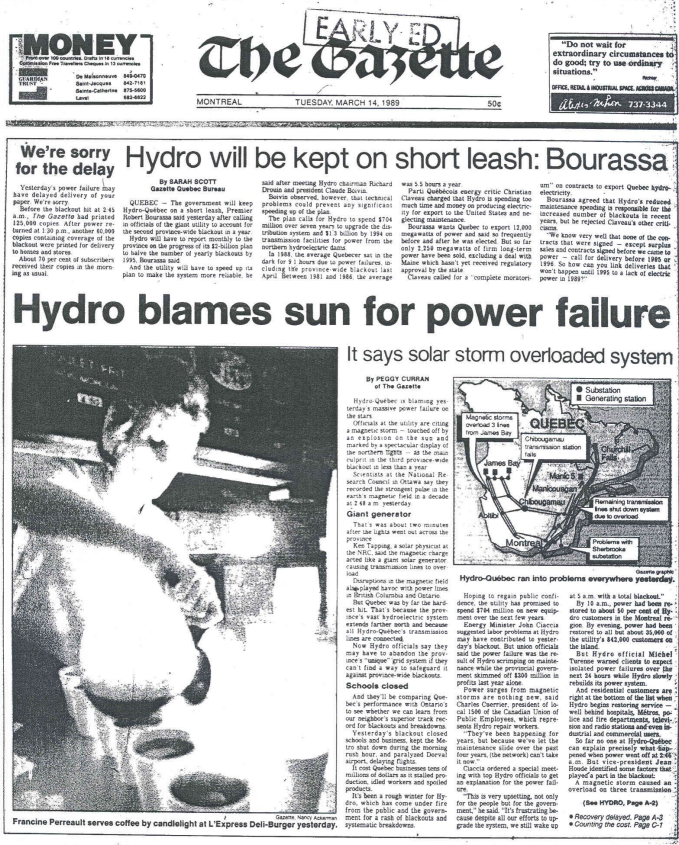
One of the key roles of reactive power is to maintain voltages at appropriate levels, and when reactive power is withdrawn from the grid, voltages begin to sag. If the voltage gets too low, this can cause the devices responsible for maintaining voltage to go into protection and trip offline, further lowering the voltage and causing even more devices to trip offline. This is known as a “voltage collapse” and can lead to a large-scale blackout, and it is exactly what happened during the 1989 geomagnetic storm and Quebec blackout.
Some auroras were seen tonight (11/12) as leftover energy from the CME reached the Earth’s magnetosphere, but activity was far less than last night. Still – what an experience last night. 2025 was/is our solar maximum, so there is still plenty of solar flare activity – and with it – the potential for more auroras. If you have the chance to see one, do it – it is an incredible experience.