During June 2023, I went to the annual Northwest Gas Association (NWGA) conference in Sunriver, Oregon. The NWGA is a trade organization that represents the natural gas industry in the Pacific Northwest, and one of their biggest foci these days is the role of natural gas generation in resource adequacy across the Western U.S. Resource adequacy refers to the ability of electrical generation to meet demand, and natural gas plants play a huge role in this because they are dispatchable plants that can quickly adjust their generation to meet changes in load. Compare this to coal and nuclear plants, which are very slow to start and have limited flexibility in their generation output. Next-generation nuclear reactors are much more flexible than current reactors, but those are likely still a decade out from being deployed in the United States.
Natural gas is not without its weaknesses of course – it is a carbon-emitting resource, the plants can trip offline, fuel prices can be highly volatile, and as Winter Storms Uri and Elliot showed, unwinterized gas infrastructure can catastrophically fail during cold waves. But overall, it is an economic, flexible, and relatively clean energy source that balances out the intermittency in wind and solar well, particularly over extended wind/solar droughts where short-term battery storage cannot pick up the slack.
During that conference, Mark Holman, the managing director of Powerex, gave a great presentation on resource adequacy and the current state of power trading across the Western U.S. Powerex is a wholly owned subsidiary of BC Hydro and is responsible for wholesale physical & financial electricity and natural gas trading across Canada, the U.S., and Mexico. Powerex’s trading strategy heavily leverages the flexibility of their hydro resource and they own lots of long-distance transmission, allowing them to import power when prices are cheap and store water behind the dams for future use. When prices peak in the evening after load climbs and solar generation decreases, they release this water from the dams and use their vast transmission portfolio to export into higher-priced markets. It is a very effective strategy and allows British Columbians to experience some of the lowest electricity rates in all of North America.
As a meteorologist and former real-time electricity trader who had implemented these importing/exporting strategies with hydro (albeit on a much smaller scale), I was extremely interested in his presentation. He touched on a lot of market dynamics I experienced as a real-time trader and emphasized the immense – and increasing – impact that meteorology has on power supply and demand across regions. Holman mentioned that the 2020s will feature new trading opportunities due to continued renewables & transmission build, and that the greatest resource diversity/trading opportunities would be between the Western Interconnection (WECC) and the Great Plains. The Plains have a ton of wind energy, relatively little solar/hydro, and the load peaks between the West Coast and the Plains are non-coincidental due to both the timezone differences and differing weather regimes, particularly during extreme heat/cold waves.
Holman’s presentation can be found here. Slide 15 in that presentation is the key slide that shows how additional transmission can open up new trading opportunities.
Transmission across Seams
Unfortunately, there’s one major issue with integrating wind over the Plains into the Western US, and that is that the West and the Plains lie in different interconnections. There are three major interconnections across the United States: The Western Interconnection, the Eastern Interconnection, and the Texas Interconnection, and they have very little transmission capacity between them. There is only 1,300 MW of transmission between the Eastern and Western Interconnections, meaning they essentially operate as completely separate grids.

Our electric grid uses AC (alternating current) power because AC voltages can easily be stepped up and down using transformers. However, we cannot easily build AC power lines that span interconnections because since these grids operate separately, their frequencies are out of phase. Instead, we build high-voltage DC (direct current) transmission lines to span these interconnections, as we can convert the AC to DC and back again such that the AC power imports are in phase with the rest of the grid. Unfortunately, HVDC transmission is extremely expensive due to the massive converter stations needed at each terminal to convert AC power to DC power (and vise versa), and in a system that has historically had relatively little renewable generation, there was less need for cross-seam transmission since local hydro, nuclear, and fossil fuel generation could be utilized to serve load.
But our electricity system is in a period of unprecedented change, and transmission is critical for transporting wind/solar energy from where it is produced to where it is needed. The Interconnections Seams Study, a study led by the National Renewable Energy Laboratory (NREL) with significant contributions from Iowa State University, NextEra Energy, and others, quantified the benefits of building cross-seam transmission to share energy and capacity across the interconnections. By opening up trade opportunities, cross-seam transmission allows producers to sell into more expensive markets, allows purchasers to buy energy at lower cost, and allows areas to share capacity during extreme events, which rarely impact the entire United States at once.
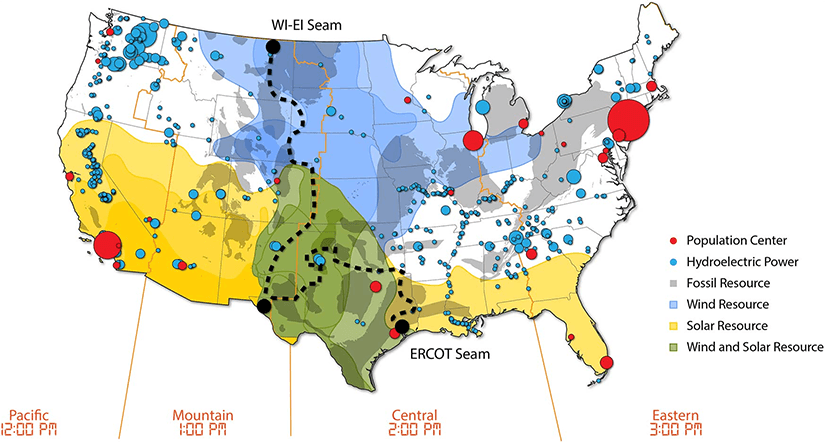
The above image is one of the most well-known images from the Seams Study, and it shows how load centers, timezones, and hydro/fossil/renewable resources all interact. Transmission is critical to take advantage of this resource and load diversity, but right now, it is the bottleneck for both transmitting power on and connecting new resources into our current electrical system.
North Plains Connector
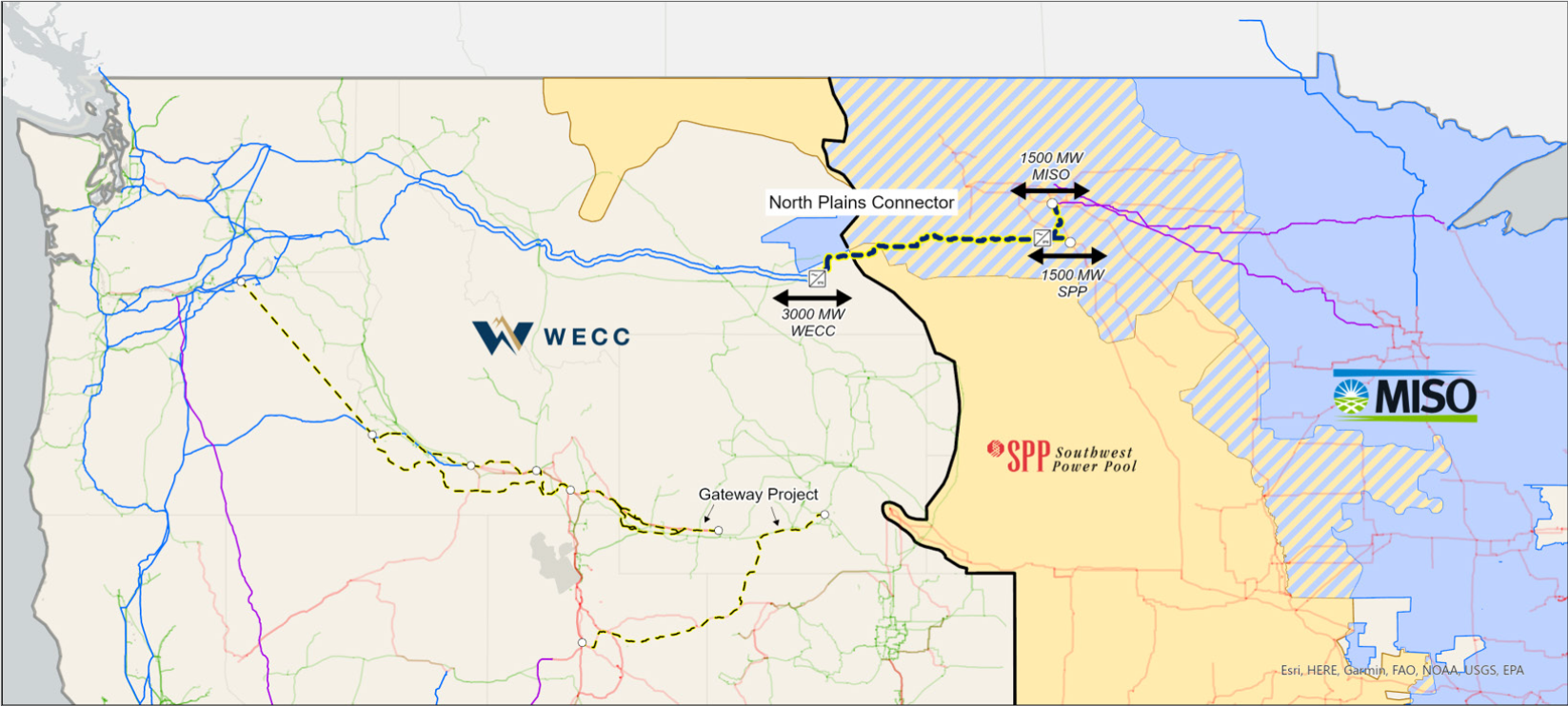
The North Plains Connector is a proposed 420 mile, 525 kilovolt, 3,000 MW HVDC line that will connect the Eastern and Western Interconnections. It is being developed by Grid United, LLC and is currently in the permitting phase, with construction expected to begin by 2028 and operations expected to begin by 2032. It spans from the town of Colstrip, Montana to two towns in North Dakota – Solan, ND in the SPP (Southwest Power Pool) footprint, and Center, ND in the MISO (Midcontinent Independent System Operator) footprint.
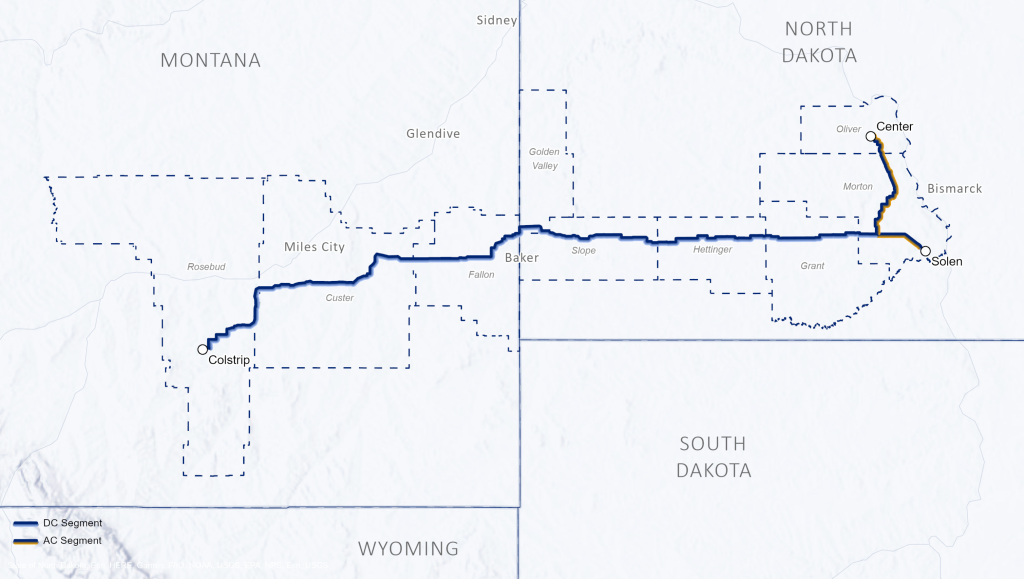
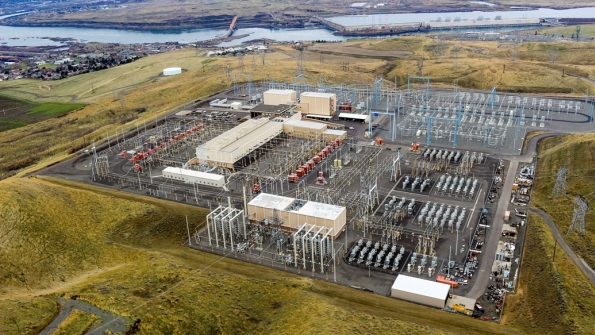
Its terminal at Colstrip allows it to make use of the Colstrip Transmission System (CTS). The CTS was built in the early 1980s to export power from the Colstrip generating facilities into the grid of Bonneville Power Administration – and by extension – many municipal, cooperative, and investor-owned-utilities in the Pacific Northwest.

Credit: Cameron Yourkowski/Renewable Northwest, prepared for Montana Department of Environmental Quality Wind and Transmission Working Group
Right now, 4 utilities have signed non-binding MOUs for a share of the North Plains Connector. Puget Sound Energy has 25% (750 MW), Portland General Electric has 20% (600 MW), and Avista and Northwestern Energy both have 10% each (300 MW). All of those utilities also own shares of the Colstrip Transmission System and the Colstrip generating facility, though PSE, PGE, and Avista have plans to transfer their shares of the Colstrip generating facility before the North Plains Connector becomes operational. Pacificorp is the only utility that has a share of CTS but has not signed a MOU for a share of the North Plains Connector, but I wouldn’t be surprised if they sign an MOU in the future.
To summarize, the United States will experience a period of unprecedented load growth over the next several decades due to the growth of large loads like server farms and data centers and the electrification of transportation and society. Dispatchable, fossil fuel plants like natural gas have an important role in that transition, but they are not the only tool at our disposal. By linking load and resources and increasing the diversity of each, transmission offers many resiliency, reliability, and economic benefits that isolated, dispatchable plants don’t, particularly during periods of severe weather. Together with other solutions like demand response programs and continuing decreases in the cost of batteries/renewables, transmission, especially interregional transmission, can play an important role in maximizing the social surplus within our power markets and helping support a reliable, economic, and clean energy system for the 21st century.