We are used to thinking of space and time as independent of each other. We imagine that there are three spatial dimensions that describe our world, and there is time, which just ‘keeps on going’ at the same rate for everybody. Time anchors us. In a crazy world with terrorism, climate change, nuclear proliferation, disease, and reality TV stars storming their way to the Republican nomination, we can all rest easy knowing one thing. At least we all abide by one common clock, right?
Wrong.
In 1905, Einstein was a 26-year-old university graduate who was working in a patent office. He enjoyed producing groundbreaking physics work in his spare time, and in 1905, he produced his theory of special relativity. This theory has two parts. First, it says that the laws of physics are identical throughout the universe for any “inertial” (non-accelerating) observer. Second, it says that the speed of light is the same for all observers. These may seem like commonsense, innocuous statements, but they have profound implications. As you will see, while some things are absolute, such as the speed light, other things are relative based on the observer, such as space and time.

Imagine that you are in a vintage race car traveling 70 miles per hour to the east, and your buddy’s jalopy is traveling at 30 mph to the west. In this case, your buddy’s car is traveling towards you at 100 mph. This is because YOUR car is not traveling away from you at all – it is traveling at a lowly 0 mph relative to you. Likewise, from your buddy’s perspective, his car is not moving at all, but your car is moving towards him at 100 mph. At first, this seems like a paradox: how can something be moving at 0 mph and 100 mph at the same time? Of course, it all makes sense when you take who’s driving the car into account. This illustrates the concept of inertial reference frame, where any arbitrary, non-accelerating object can be defined as being stationary while other objects are whizzing all around in every direction. I may think I’m stationary sitting here writing this blog, and I am from my reference frame, but try asking the man on the moon if I’m stationary. Heck, he can only see me for half of the day!
Weird things happen when you travel at speeds close to the speed of light. Say, for example, that I am flying in a spaceship at the speed of light to the east, and my buddy is flying at the speed of light to the west. It would seem, then, that from my inertial reference frame, my buddy is traveling at two times the speed of light away from me. In the graphic below, ‘c’ stands for the speed of light, while ‘2c’ stands for twice the speed of light.

However, this is not possible. Due to the theory of special relativity, since we are both non-accelerating objects, the same laws of physics apply for us, and the speed of light is the same for us. Nothing can travel faster than the speed of light. Therefore, my buddy is only traveling the speed of light away from me, not twice the speed of light. How can this be?

In the car example, the speed of my car was completely dependent on reference frame. I could’ve been going 0 mph or I could have been going 100 mph. If there was a hitchhiker standing on the side of the roadway, he would have said I was going 70 mph. And as it turns out, time, just like speed, position, and so many other things, is relative.
If I’m traveling at light speed away from my buddy and he doesn’t appear to be going anywhere, then time is going normally for me, but no time has passed for him. If time was going for him, he would be moving!
And because the speed of light is equal to length divided by time, if time is relative, it turns out that length is too! If time passes more slowly for other objects flying by the observer than the observer himself in his inertial reference frame, then the length of those objects the observer sees must contract in order to satisfy the relationship between time, length, and the speed of light. For example, if I’m flying by a spaceship at 3/5ths the speed of light, for me, the spaceship is only 4/5ths as long as it is in its own reference frame, and for every second that has passed on the spaceship, 1.25 seconds have passed for me. These concepts are called length contraction and time dilation, respectively, and they are not intuitive at all. You can learn more about them here.
There are other consequences of special relativity, a major one being that events that may appear simultaneous to one observer may not appear simultaneous to another observer. Also, weird stuff happens when you are accelerating (i.e. not in an inertial reference frame). It’s all incredibly confusing and counter-intuitive.
But what all of this stuff means is that space and time are not separate entities. They are intrinsically woven together, and we call this entity space-time.That’s right: in our overly chaotic world, space and even time are relative to the observer. Thankfully, these effects only become noticeable when traveling at “relativistic” speeds… i.e., speeds approaching the speed of light. Otherwise, I imagine everyday communication would be quite difficult!
For example, let’s imagine that the aforementioned rockets can go at all speeds. The dashed line here represents the relative speed of one rocket from another (in terms of its velocity divided by the speed of light) if we just take the sum of the parts like we did with the cars. The blue line shows the relative speed if we take special relativity into account, like we did with the rockets. There isn’t much of a difference until after v/c=.1, meaning that the velocity (v) is 1/10th the speed of light. One tenth the speed of light is 66,960,000 miles per hour! So yes, relativity affects us all, but the effects are so small that it is impossible for us to notice them. Still it’s fascinating to know that any movement has an effect on time and length from your reference frame.

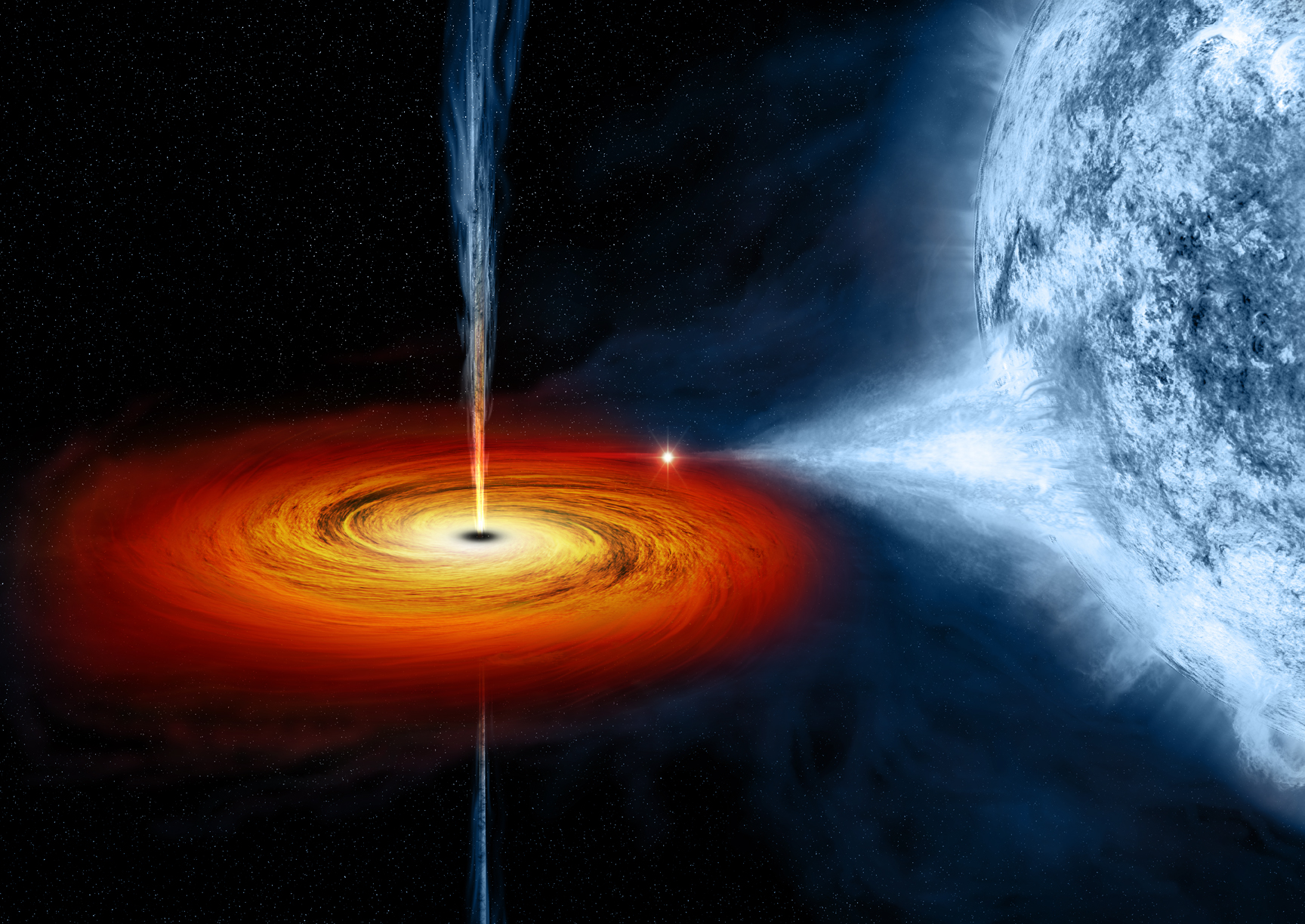
That’s it for special relativity! Click on the hungry black hole below if you want to learn about Einstein’s magnum opus, his theory of general relativity.