
Retrieved from the NWS
If you see a green flash, there is no need to duck for cover; Lord Voldemort isn’t trying to kill you. A green flash is a very rare sliver of green light most usually seen right after sunset or before sunrise.
Let’s use a setting sun as an example, as green flashes are most commonly seen at sunset. Green flashes occur because light is refracted as enters the atmosphere. Light moves more slowly in the denser air nearer the ground than the thinner air aloft. Out of all the colors in the visible spectrum, red has the longest wavelength, and violet has the shortest. Shorter wavelengths follow closer to the curvature of the Earth when the sun is right at the horizon. Therefore, as the sun sets, the longer wavelengths (first red, then orange, then yellow) disappear because they don’t follow the curvature as closely as the shorter wavelengths (green, blue, violet) and therefore travel faster since they are higher up, where the air is thinner and light travels faster. Green, meanwhile, stays in the lower atmosphere and travels slower, so green is the last color we see, with it being more yellowish at first and more blueish at the very end before it dies out.
Why don’t we get blue or violet flashes then? These types of light are generally scattered throughout the atmosphere as the sun sets. Otherwise, we’d see violet flashes. On very rare occasions, however, you can see a blue flash, especially if the air near the surface is very dense and the air aloft is much lighter (like an inversion).
There are four types of green flashes. These are the inferior-mirage, the mock-mirage, the sub-duct, and the green ray. The inferior and mock-mirage flashes are by far the most common, making up 99% of all green flashes, with the inferior being the commoner one. I saw an inferior green flash, and the picture at the top is an inferior green flash as well.

Credit: Vic and Jen Winter, 2001
Inferior green flashes are formed when the air at the surface is warmer than the air above. They are best seen at sea level.
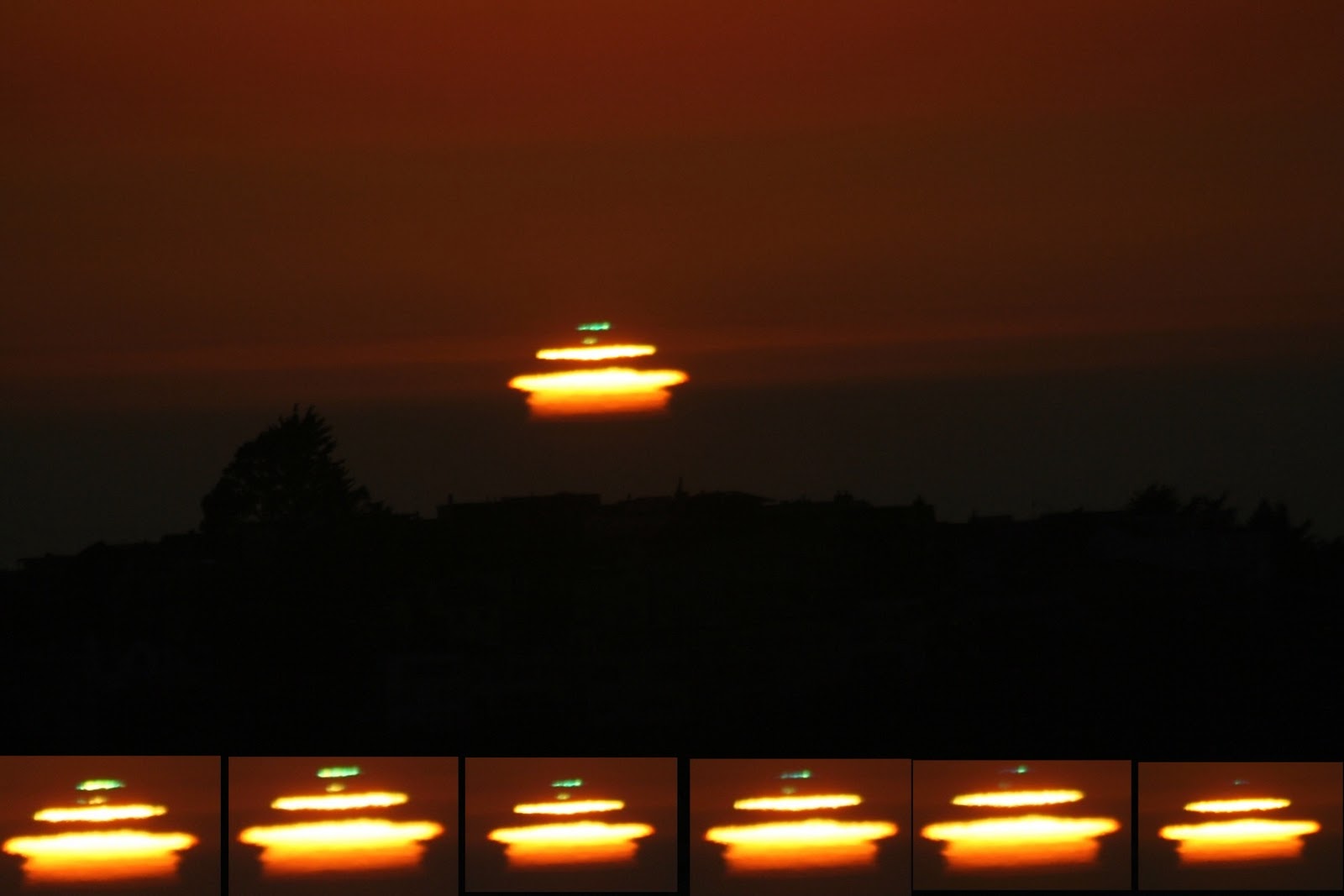
Credit: Mila Zinkova, San Francisco, CA, September 17, 2006
Mock-mirage green flashes are formed when the air at the surface is colder than the air above. They are best seen above sea level.
Sub-duct flashes are extremely rare. Unlike mock-mirage or inferior green flashes, which only last for a second or two, sub-duct flashes can last for over 15 seconds. There is a fantastic sequence of a particular sub-duct green flash here.

Charlie Phillips, taken August 2011
A duct is a horizontal layer in the atmosphere that traps various types of waves below it. The picture above shows a Fata Morgana, a rare mirage caused by an atmospheric duct, with the top of that “fog bank” being the duct. Although it isn’t perfectly lined up, you can sea how the boat ahead has a distorted appearance.

Credit: Guillaume Dargaud
Green rays are also extremely rare and only form when a bright green flash occurs in hazy air. Instead of a simple point of light, a green ray is a beam of light that lasts for a few seconds.
Next time you are by the sea near sunset, keep an eye out for a green flash! They are rare, but that makes them all the more special.