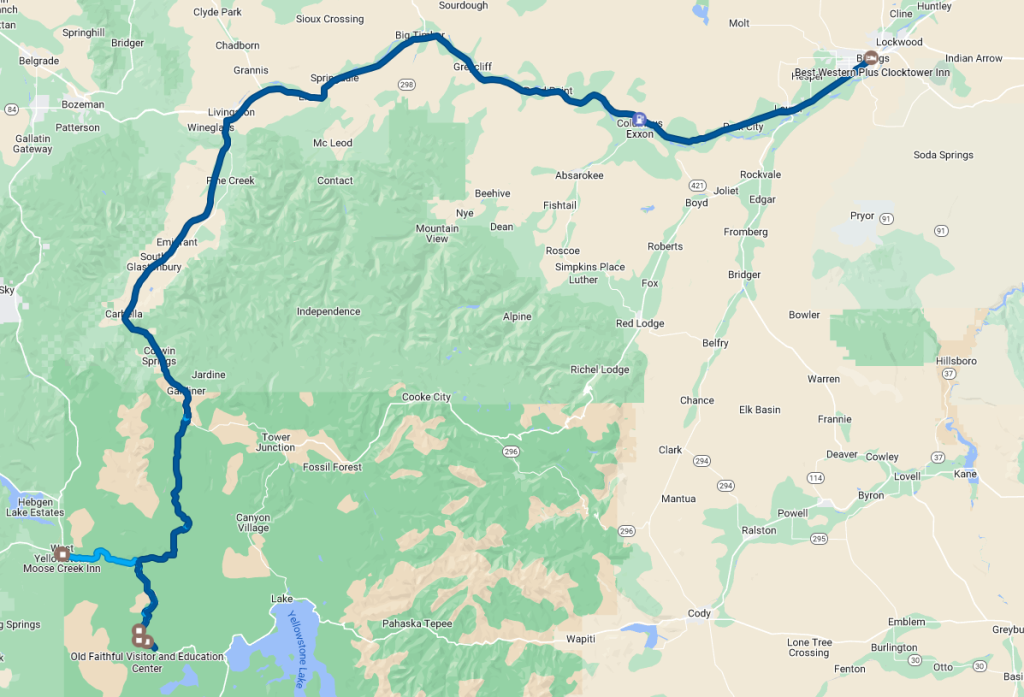
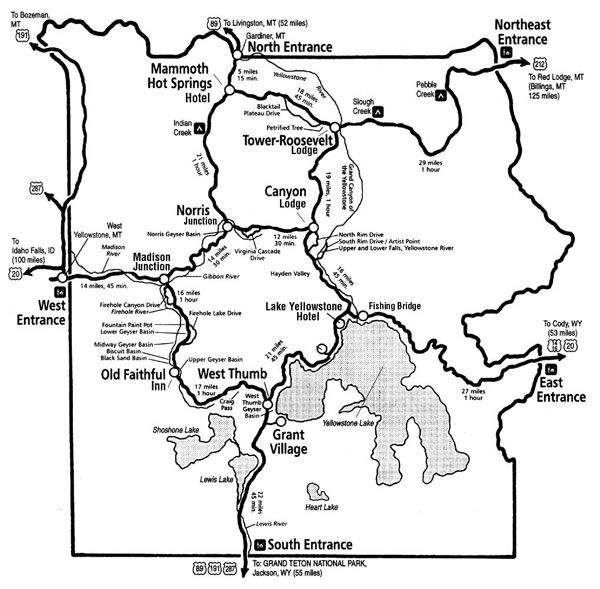
We set aside our third road trip day to explore Yellowstone National Park. A significant portion of the park was still closed due to heavy snowfall on the roads (most of Yellowstone is between 6,500 and 10,000 feet), but the Upper and Lower Geyser Basins were open and we spent most of the day there These basins contain some of Yellowstone’s most famous features, such as Old Faithful and the Grand Prismatic Spring.
Credit: National Park Service
We left Moose Creek Inn around 8:30 am and quickly got some pastries at Mama Bear Bakery in West Yellowstone. After getting some grub, we jaunted down to the street to the West Yellowstone visitor’s center to learn about places to see and any road closures. Much of the southern and eastern portions of the park were still closed due to snowfall, but Upper and Lower Geyser Basins from Madison Junction south to the Old Faithful Inn were all open. The center also had an exhibit where you could touch the fur of all the animals found in the park, such as foxes, coyotes, wolves, elk, moose, bears, bison, otters, and a few others that escape me at the moment. It’s easy to see why otter pelts and buffalo hide were such prized commodities before their commerce was outlawed; they were extremely comfortable and warm and ideally suited for the brutally harsh winter of the Northern Rockies.
Fountain Paint Pot Trail
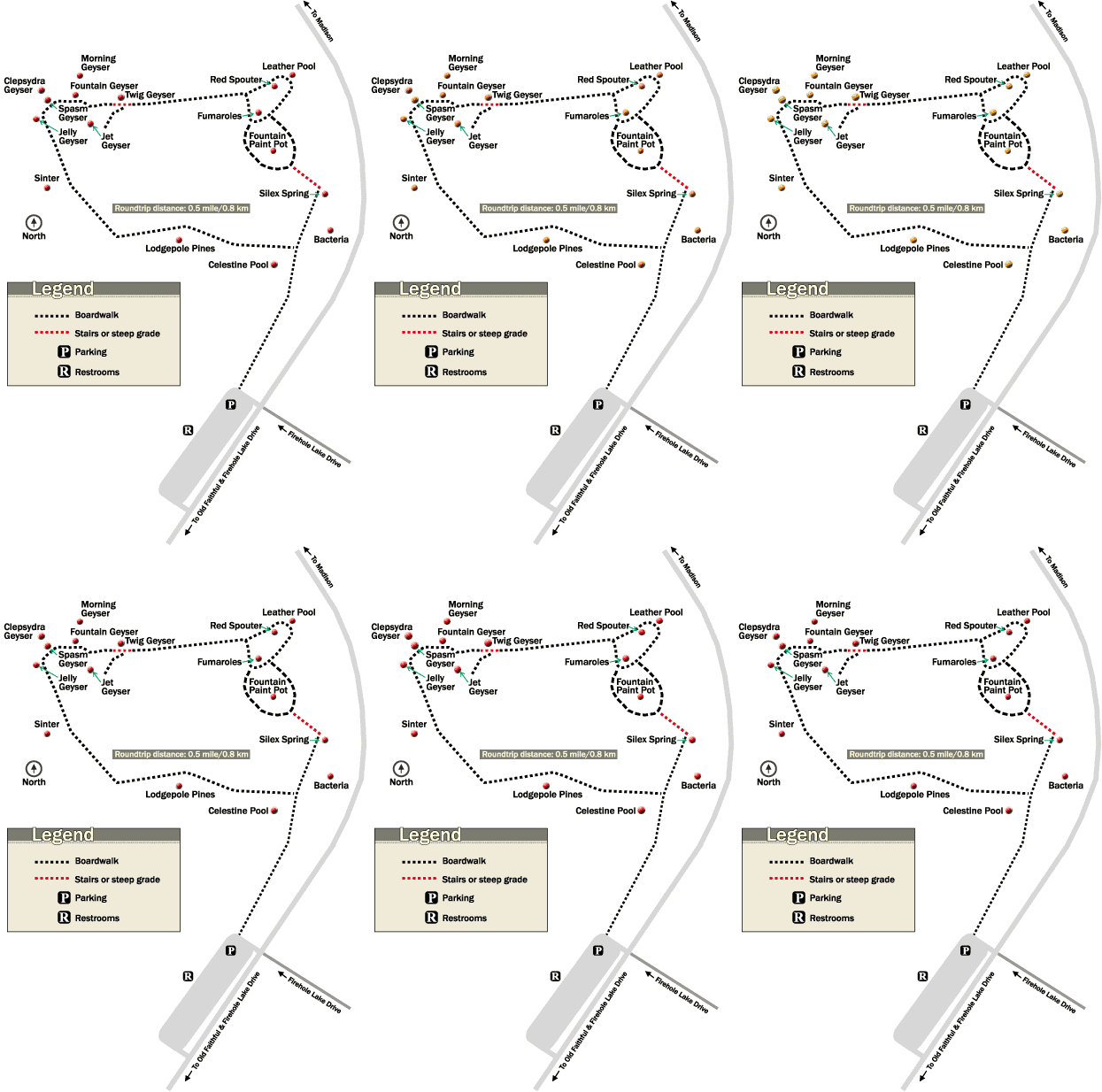
Our first stop was the Fountain Paint Pot trail, south of Madison Junction along the Firehole River. The loop featured multiple springs, geysers, and most notably – bubbling pits of liquified volcanic rock. The stop’s namesake pit was a pool of thick, gooey, boiling mud/clay, like Mother Nature was cooking a giant vat of smelly Cream Of Wheat.
Credit: National Park Service
The stop’s namesake pit was a pool of thick, gooey, boiling mud/clay, like Mother Nature was cooking a giant vat of smelly Cream Of Wheat.
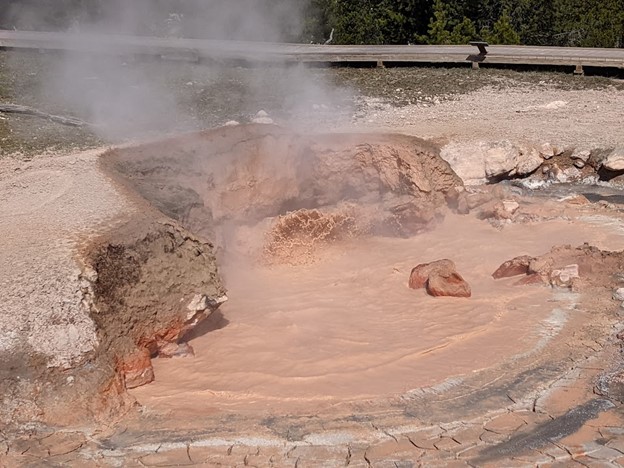
Another highlight was the “Red Spouter,” which formed back in August 17,1959 after a 7.5 magnitude earthquake rattled the park. Similar to the Fountain Paint Pots, the red spouter is composed of superheated groundwater, hydrogen sulfide gas, liquified rhyolite (volcanic rock), thermophiles (heat-loving microorganisms), and trace minerals, except with a distinctive red tint compared to the fountain paint pots. It was fascinating to watch the Red Spouter noisily gurgle up water and hydrogen sulfide gas.
The Clepsydra Geyser was yet another highlight of the Fountain Paint Pot basin. Unlike Yellowstone’s most famous geyser – Old Faithful (which we saw a few hours later) – the Clepsydra Geyser is constantly bubbling but lacks the periodic, sky-high eruptions characteristic of some other geysers. Geysers form when superheated water – occasionally up to 900 degrees – rises to the surface but becomes constricted in the process. As more water rises and the pressure below increases, the constriction eventually gives way, allowing this superheated water to shoot skyward and quickly vaporize into steam. The Clepsydra Geyser was less constricted than Old Faithful and would not accumulate pressure over time, while Old Faithful would gradually build pressure as superheated water rose to the surface until finally releasing it in a much more explosive manner.
Midway Geyser Basin
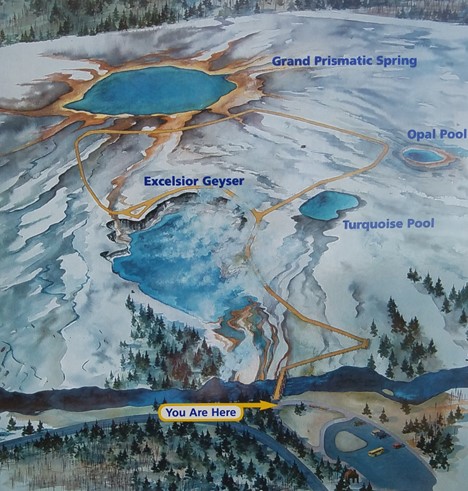
Our next stop was the Midway Geyser Basin. The Midway Geyser Basin contains the Grand Prismatic Spring, which is the third-largest hot spring in the world at 370 feet across and 160 feet deep. Unfortunately, the lookout point for the spring was still closed due to heavy snow, and the spring is so vast that you really need an aerial view to experience its full grandeur. Still, we stood next to the spring and were astounded by its size and beauty.
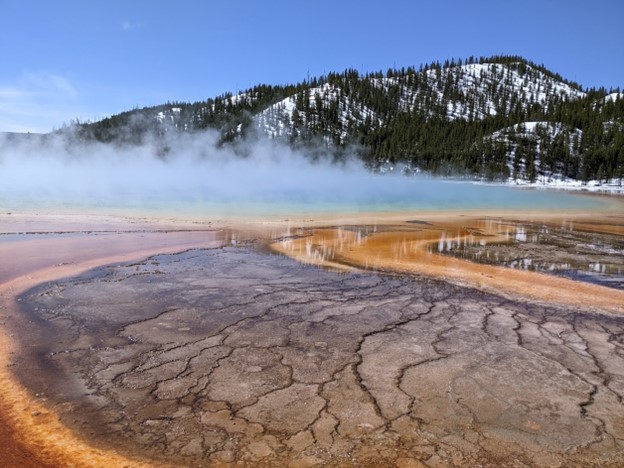
All of the hot springs we saw had a very distinctive color pattern, with perfectly clear water in the center devoid of any life and orange “mats” towards the edges composed of various bacteria. The center of the springs are generally too hot for any life, but the edges can support single-celled organisms that have adapted to the extreme temperatures found in the pools. The water temperature in the Grand Prismatic Spring is approximately 190 degrees in the center but cools to 140 degrees at the edges where these microbial mats are found.
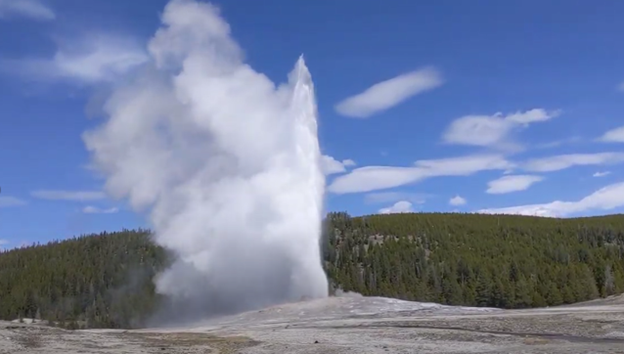
After viewing the Midway Geyser Basin, we decided to go straight towards Old Faithful to see the next time it was going to eruption. The man at the visitor center in West Yellowstone said that Old Faithful erupts, on average, every 96 minutes. Unfortunately, as we were driving towards the Old Faithful parking lot, we could see it just finishing its eruption. The eruption occurred around noon, and the Old Faithful visitor’s center estimated the next eruption at 1:33 pm +- 10 minutes. We looked at some exhibits at the visitor’s center for a bit then made our way outside to the geyser around 1:15 pm. Sure enough, Old Faithful began erupting around 1:38 pm, with the peak eruption lasting around one minute and slowly winding down over the next two minutes. It lives up to its name!
The road south of Old Faithful and looping around Yellowstone Lake was still closed for the season due to snow, so we headed back north and saw the Black Sand and Biscuit Basins.
Black Sand Basin:
The Black Sand Basin is so-named for the black, obsidian sand surrounding the springs and geysers. By this time, I was so accustomed to the dramatic, blue-orange hot spring pools, but I was particularly struck by one tiny little, no-name geyser in the middle of the basin steadily spewing away. It may not have the size of the other geysers but it sure has a strong work ethic!
Biscuit Basin:
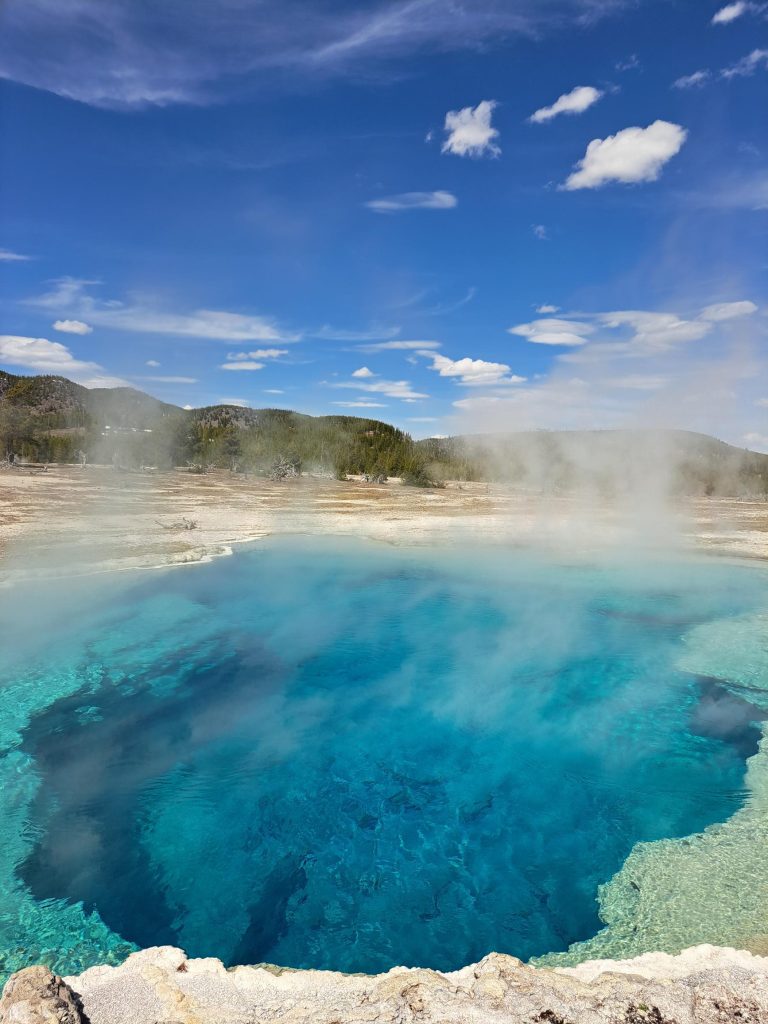
Biscuit Basin was noteworthy for its Sapphire Pool, a particularly deep and blue hot spring. It looked so inviting… but looks can be deceiving and these hot springs are killers. All along the park, signs warned of the dangers and deaths from wandering off the designated trails to get a closer look at these hot springs. Honestly, I was surprised that the boardwalks did not have fences or guardrails preventing people from wandering off the trail, but the lack of signs allowed us to get a much closer and more intimate look at these incredible works of nature.
Bison!
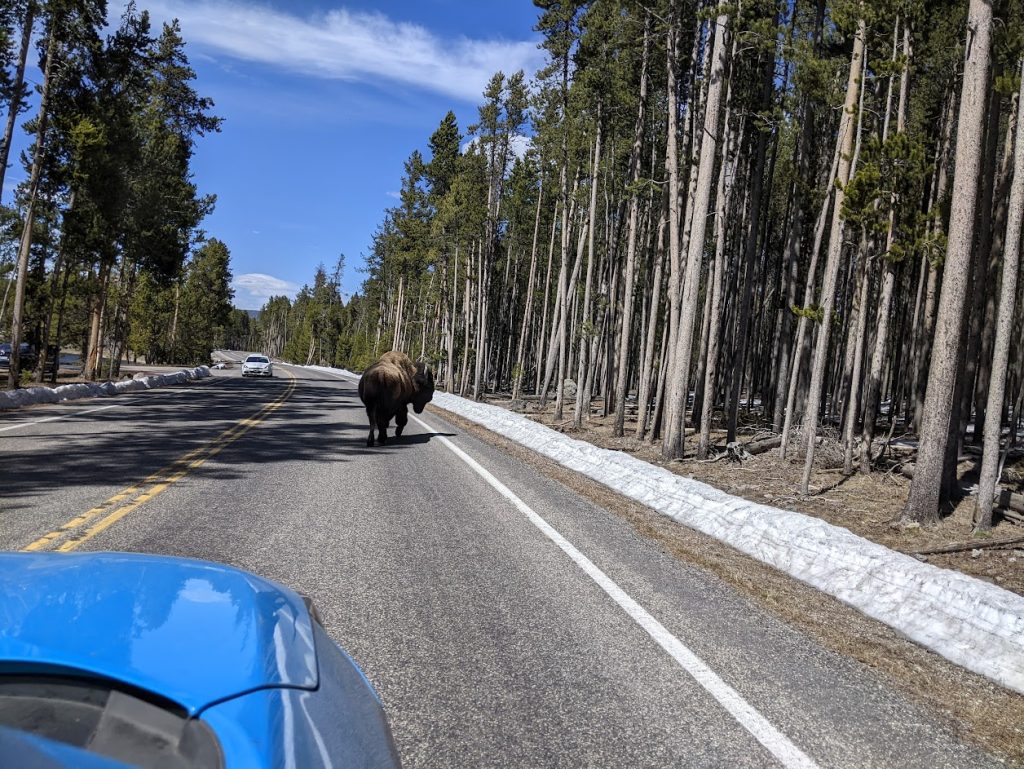
After exiting Biscuit Basin and driving north towards Madison Junction, we came across several herds of bison right along the roadway. There was even one lone bison that was walking directly on the road! We were on a two-lane highway, so oncoming traffic had to stop and both directions had to communicate to share one lane, similar to a construction zone on an undivided highway.
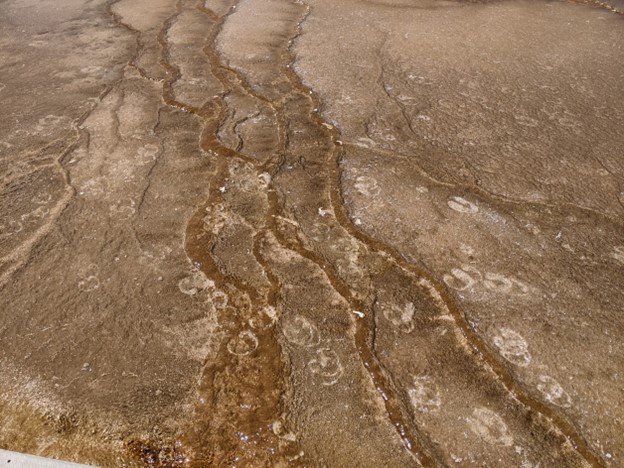
Bison were all around the park, but we were shocked by how frequently we saw bison tracks and bison scat right next to some of the hot springs and geysers. It makes you wonder how many bison have perished by falling into a spring or being scalded by a geyser. It’s natural that the bison would be attracted to the warmth and water, but you hope there would be some shared understanding in the herd, passed down through generations, that these springs and geysers are very dangerous.
Steamboat Geyser:
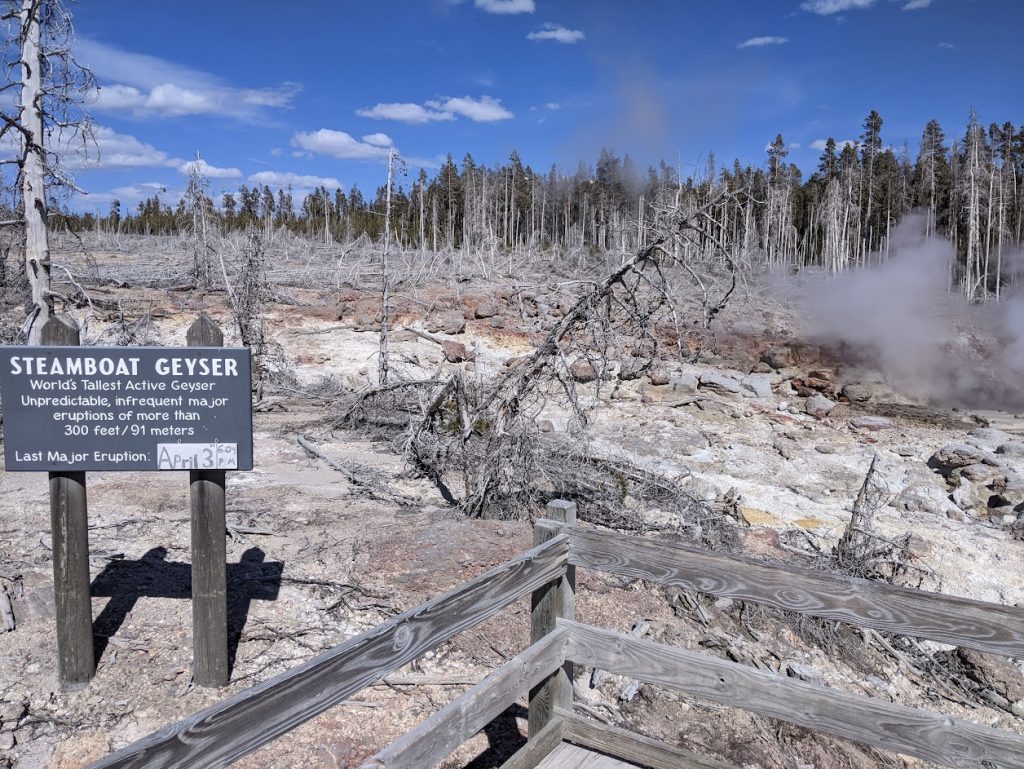
We had a couple more stops left in the park as we continued to head north: the Steamboat Geyser in Norris Geyser Basin, Gibbon Falls just north of Norris, and then Mammoth Hot Springs near the northern gate to Yellowstone National Park. Steamboat Geyser is the highest geyser in the world with major eruptions approaching 300 feet tall, but these eruptions are irregular and infrequent. Interestingly, Steamboat Geyser used to have smaller, more frequent eruptions – similar to Old Faithful – but along the way something changed and it no longer experiences these.
Mammoth Hot Springs:
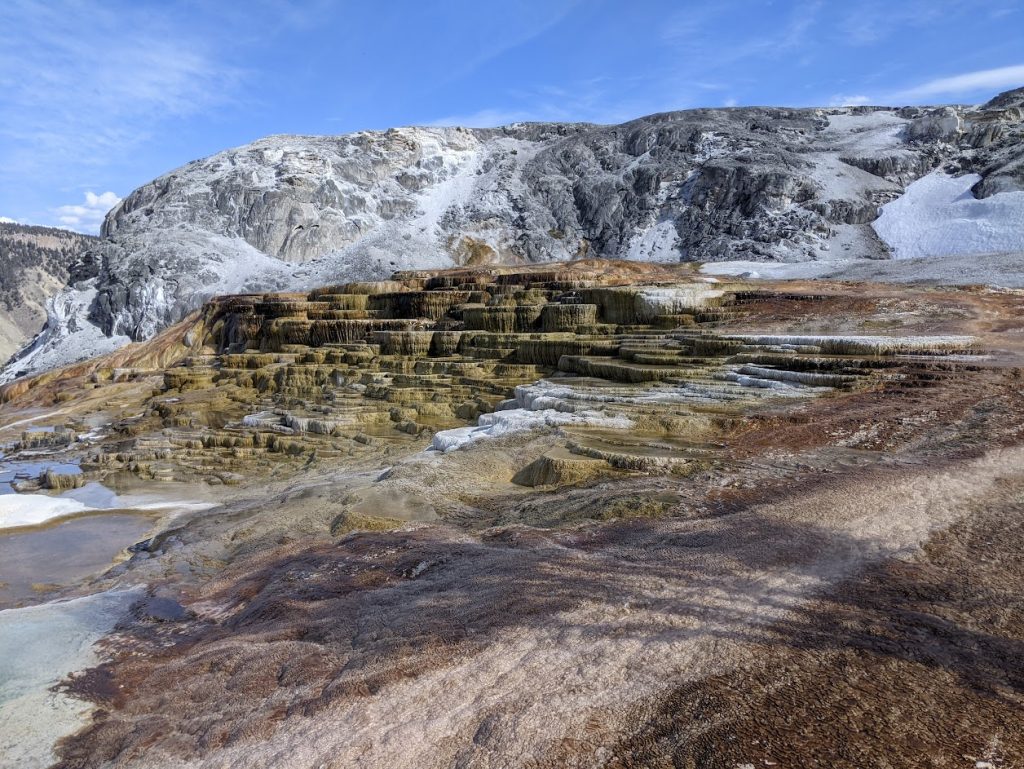
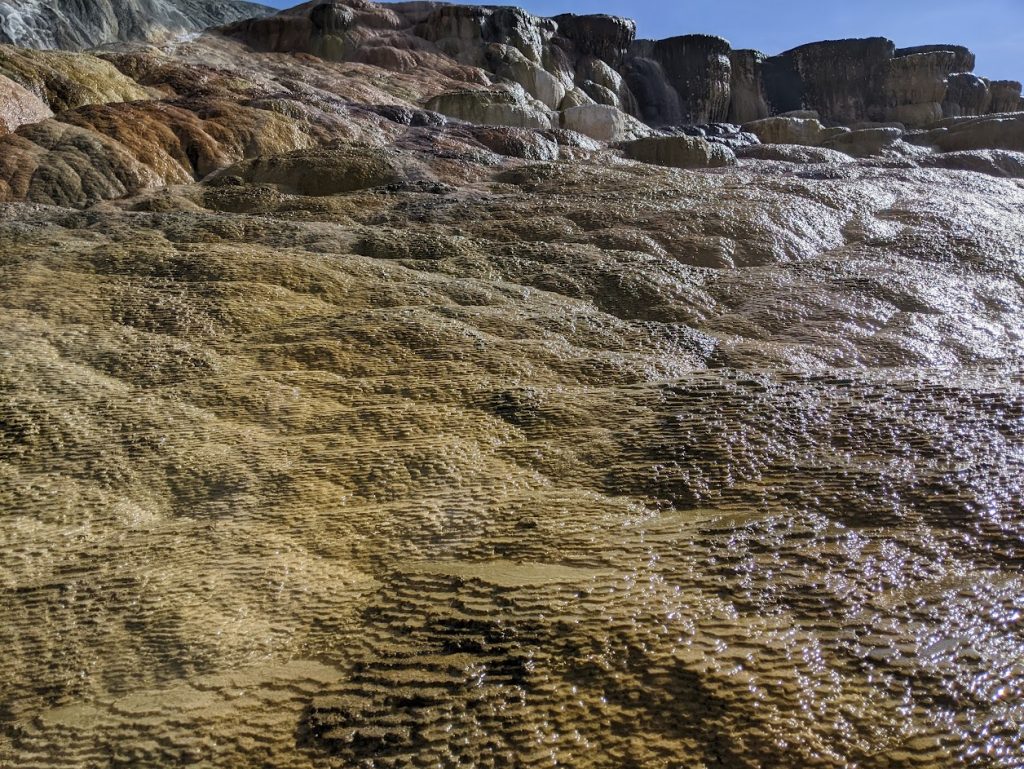
Mammoth Hot Springs was a whole different animal than all of the previous basins. Though the actual hot springs themselves were less impressive or numerous than the springs and geysers in the other basins, Mammoth Hot Springs had these fantastical, beautiful terrace-like structures resulting from the deposition of dissolved calcium carbonate in the spring itself. The spring was also located high on a hill, so these terraced structures extended hundreds of feet in elevation. Terracing was evident across all spatial scales, ranging from millimeter-tall corrugated textures to large, jar-like structures holding several meters high with spring water overflowing their sides.
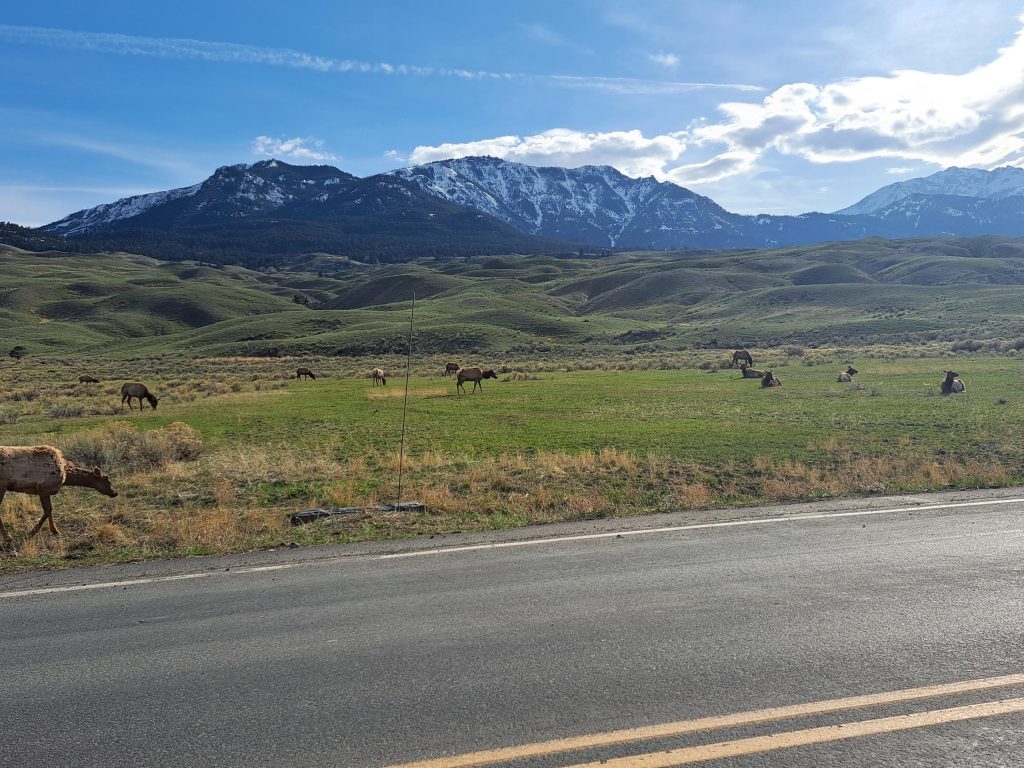
We finally left Mammoth Hot Springs in the late afternoon and exited the north gate to the park. The final drive was dizzying, with a steep decline down a narrow, unguarded roadway. It was a beautiful but white-knuckling drive. Just before the park gate, we came across a herd of elk that were beginning to shed their winter hides. These were the first large mammals we’d seen in the park aside from the buffalo along the Firehole River. I took a quick picture of these elk just before the park exit, with the majestic, snow-capped, 10,000-foot high Gallatin Range in the background.
After exiting the park, we made the trek up to Billings, MT to spend the night. Our total mileage for the day was “only” 229 miles, but we made memories to last a lifetime.