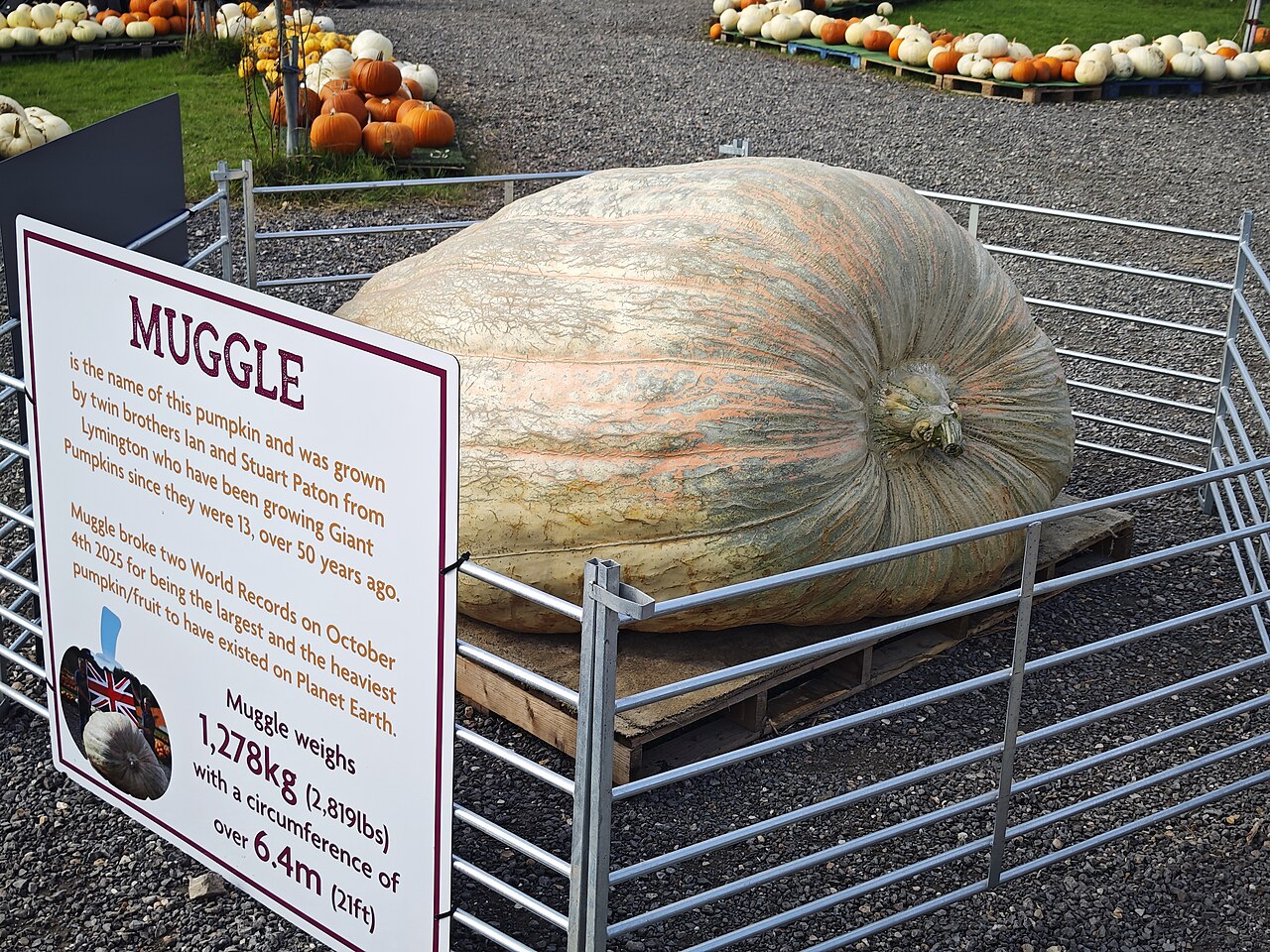
On October 13, 2025, the world-famous Half Moon Bay pumpkin festival had its 52nd annual pumpkin weigh off. The winner was Brandon Dawson, an engineer for Rivian Automotive who has been growing gargantuan pumpkins for five years. Last year, Brandon placed second, with his pumpkin just 6 pounds below the first-place finisher, Travis Gienger of Minnesota. Travis Gienger holds the U.S. record with a pumpkin of 2,749 pounds during the 2023 Half Moon Bay contest. The world record was set earlier this month by Stuart and Ian Paton of Lymington, England with “Muggle,” a 2,819 pound pumpkin measuring 21 feet in circumference!
Brandon Dawson’s 2,346-lb pumpkin just won the 2025 World Championship Weigh-Off! See it up close at the Half Moon Bay Art & Pumpkin Festival, happening this weekend (Oct 18–19) on Main Street! pic.twitter.com/QDEhvcgAad
— Visit Half Moon Bay (@VisitHMB) October 14, 2025
To get to such a massive size within one season, these pumpkins put on 50-80 pounds per day at their peak. The timelapse below shows a relatively petite 700 pound pumpkin putting on nearly 50 pounds a day.
Still growing strong: 700lbs and gaining 49lbs a day pic.twitter.com/yGshMNRzJp
— dgemeryought (@dgemeryought) September 24, 2022
The size of pumpkins at the Half Moon Bay festival has steadily crept upwards through the years and shows no signs of stopping. It seems that it is only a matter of time before we see a 3,000 pound pumpkin. According to an article in Scientific American, Gienger believes he may see a 4,000 pound pumpkin in his lifetime. I wonder what the limiting factor will be; the ability of the pumpkin to reach a certain size, or the ability of it to not collapse under its own weight!
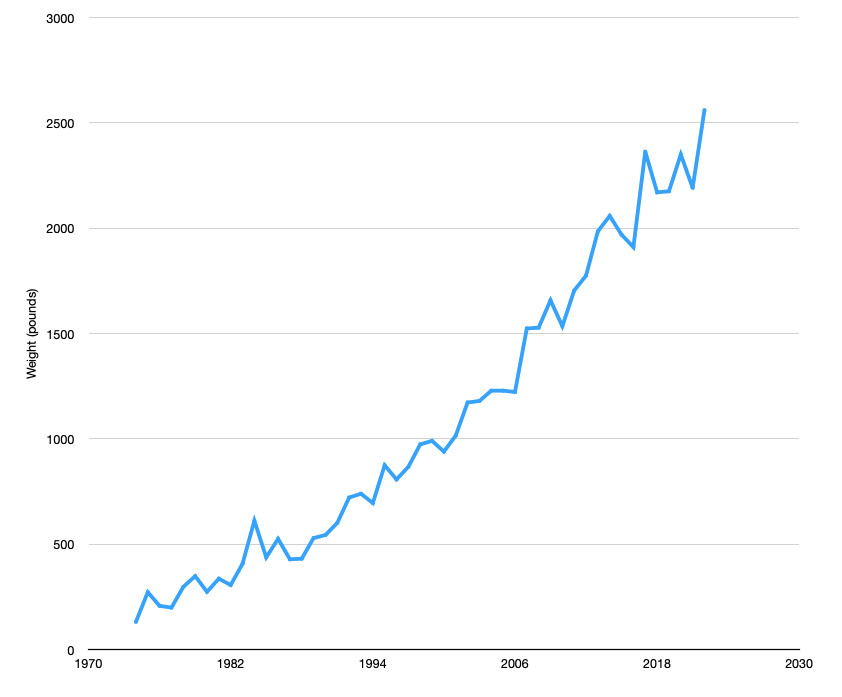
Credit: Wikimedia Commons user CodeTalker
Pumpkins and squash all belong to the gourd family, Cucurbitaceae. Cucurbitaceae are further divided into three main groups: Cucurbita maxima, Cucurbita moschata, and Cucurbita pepo. The primary distinguishing characteristic between each is the sturdiness of their flesh and their shelf lives. Maxima are the driest and sturdiest, pepo are the most delicate with the shortest shelf life, and moschata are somewhere in between. All three groups have wildly different sizes and colors. The below image shows just a few cultivars from each group.
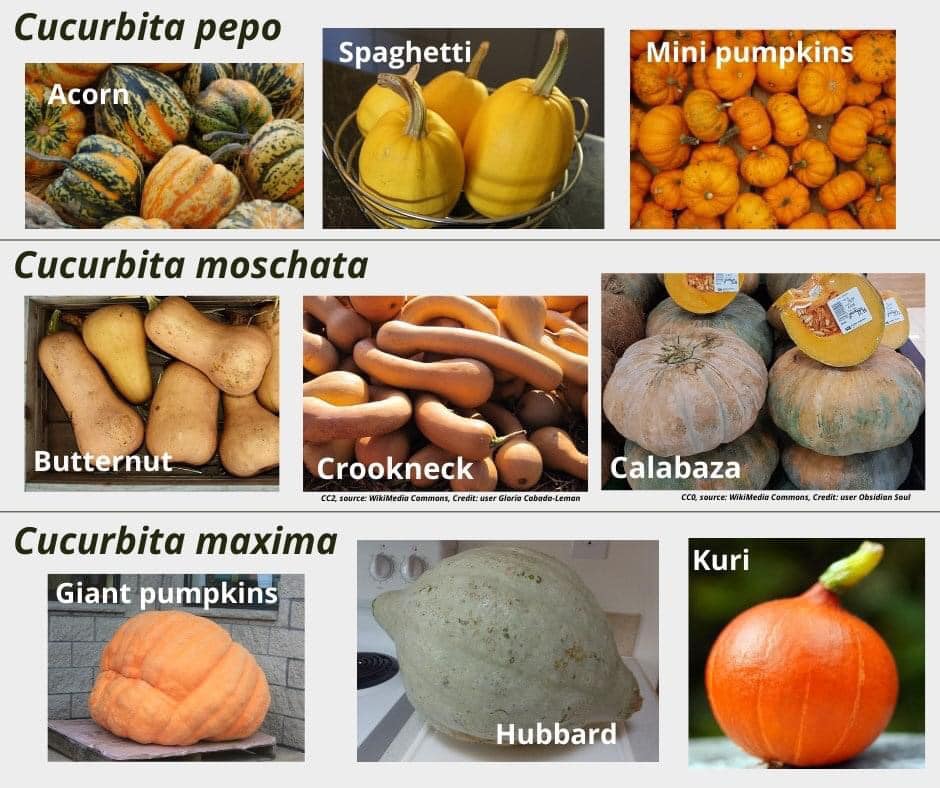

Most pumpkins on display at grocery stores are of the pepo variety. However, the giant pumpkin cultivars are all of the maxima variety. The biggest pumpkins today are of the Atlantic Giant cultivar and are descendants from pumpkins grown by Howard Dill, who set 4 consecutive world records for the largest pumpkin grown.
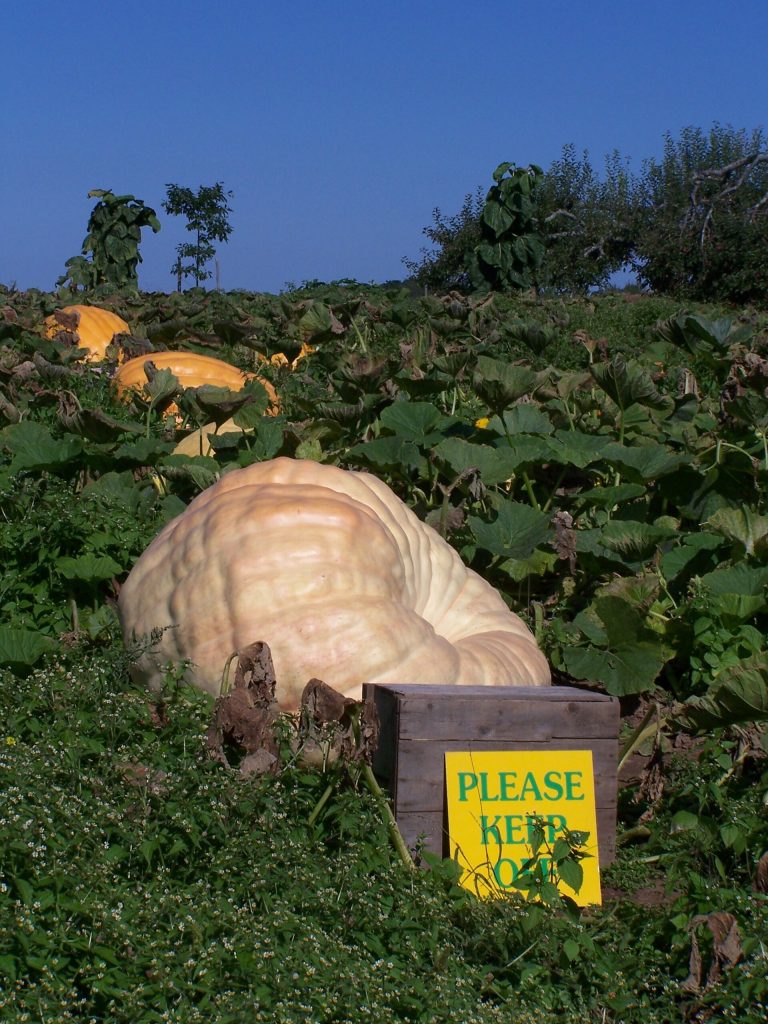
Credit: Wikimedia Commons user SheDreamsInRed
Dill spent countless hours cross-breeding different maxima pumpkins for optimal size and color, and he registered his variety, “Dill’s Atlantic Giant,” with the U.S. Department of Agriculture’s plant variety protection office in 1986. The seeds from today’s 2,000+ pound pumpkins are in very high demand by professional growers and can fetch a price of up to $500 a seed! This site has seeds from recent award-winning pumpkins for sale.
Process for Growing Record-Breaking Pumpkins
Growers sow their pumpkin seeds in mid-late April and harvest in early October, leaving up to 160 days for the pumpkins to grow. Prior to flowering and fruiting, growers begin pruning the vines by forcing them to grow in a “Christmas Tree” shape, with secondary vines radiating 10′ – 12′ from the main vine. All tertiary vines (the vines originating from secondary vines) are pruned. This pruning is necessary to ensure that the plant focuses its energy on growing the fruit and not additional vines, and the “structure” of the pruning itself can further “encourage” or “train” the vine to grow the fruit most efficiently. Once the plant has flowered and fruits have developed, all fruits except the largest, healthiest fruit are pruned so that the pumpkin focuses all its energy towards growing that one fruit. Growers also remove any weeds, as weeds expend energy that could be utilized towards growing the pumpkin.
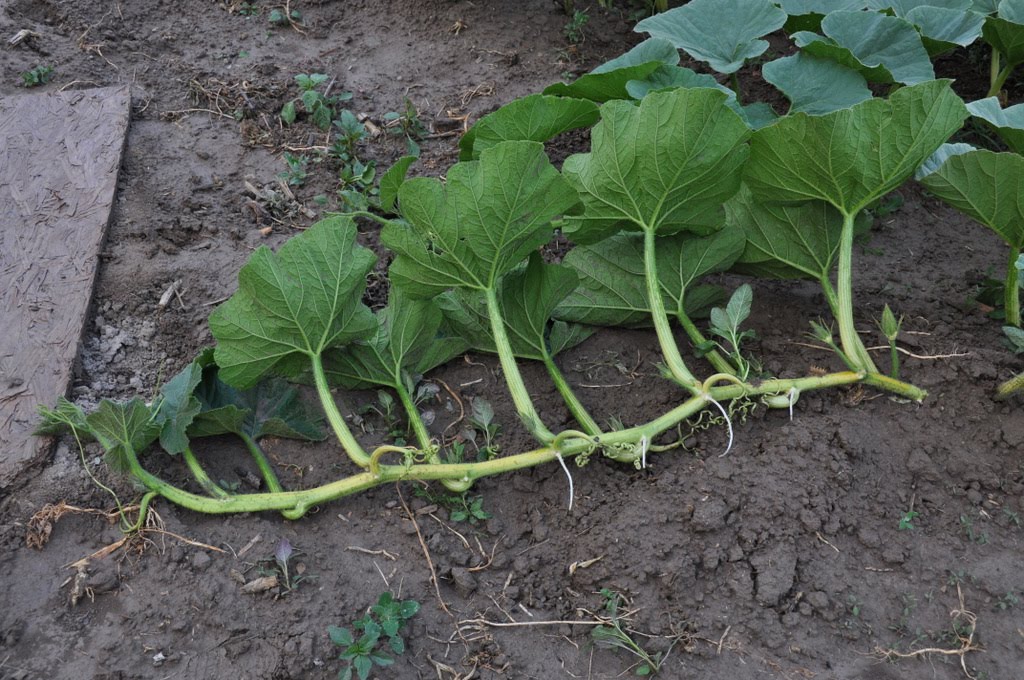
Pumpkin growers also encourage the development of “secondary roots” by burying pumpkin vines. These secondary roots form where the leaf stem meets the vine and are visible as the white roots in the image below. The more roots, the more nutrients and water the plant can draw from the soil, and the larger the pumpkin can grow.
Credit: Cliff’s Giant Pumpkin Blog
Growers provide as much sunlight as possible for the plant in its beginning stages. But as it matures, pumpkins need more shade. This is because direct sunlight can harden the skin, making it less pliable and thus restricting growth. There is a delicate balance between keeping the pumpkin pliable enough to support explosive growth, while still keeping it sturdy enough so that it doesn’t collapse under its own weight.
Needless to say, giant pumpkins require tons of fertilizer and water. According to Gienger, each giant pumpkin requires 150 – 200 gallons of water per day at peak growth! This translates to approximately 1250 – 1650 pounds of water each day. Pumpkins are 90% water, so a growth rate of 50 pounds per day doesn’t seem too outlandish when considering the amount of water these pumpkins require. As with all squash, there are two main processes by which pumpkins grow: cell division, which only occurs during the first ~20 days after fruiting, and cell expansion, which occurs for the remainder of the growing season.
Pumpkin growth can be further stimulated by growth hormones, which can be thought of as the “steroids” of the pumpkin world. Growers will often spray their crops with gibberellic acid, a natural hormone that stimulates cell growth. Pesticides and fungicides are also necessary to ensure that pumpkins are not destroyed by other organisms.
The online consensus was that Atlantic Giant pumpkins are not particularly tasty and are best used as animal feed (and the larger the pumpkin, the coarser the flesh). But I found one recipe online for giant pumpkin muffins (link here). Additionally, this blog by Cliff Warren discusses his giant pumpkin grows and is a great resource for anyone interested in giant pumpkin growing. I could see how the hobby would be quite addictive, especially when you are chasing world records!
Featured image: Current world-record pumpkin “Muggle” grown by Ian and Stuart Paton, on display at Sunnyfields Farm in Totton. Credit: Wikimedia Commons user Mgiganteus1