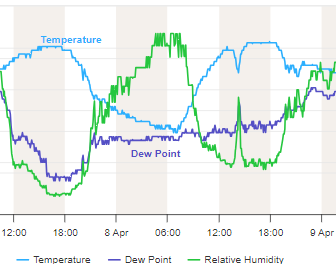
Even though I knew what to expect after witnessing my first eclipse in 2017, the 2024 eclipse absolutely lived up to the billing. Throughout the afternoon, you could feel the temperature dropping; we reached 81 degrees at 12:55 pm before falling to 75 by totality (1:50 pm) and reaching a daytime minimum of 68 at 2:15. By 2:53, temps rose back to 80 degrees, reaching a daytime max of 83 degrees just before 6 pm.
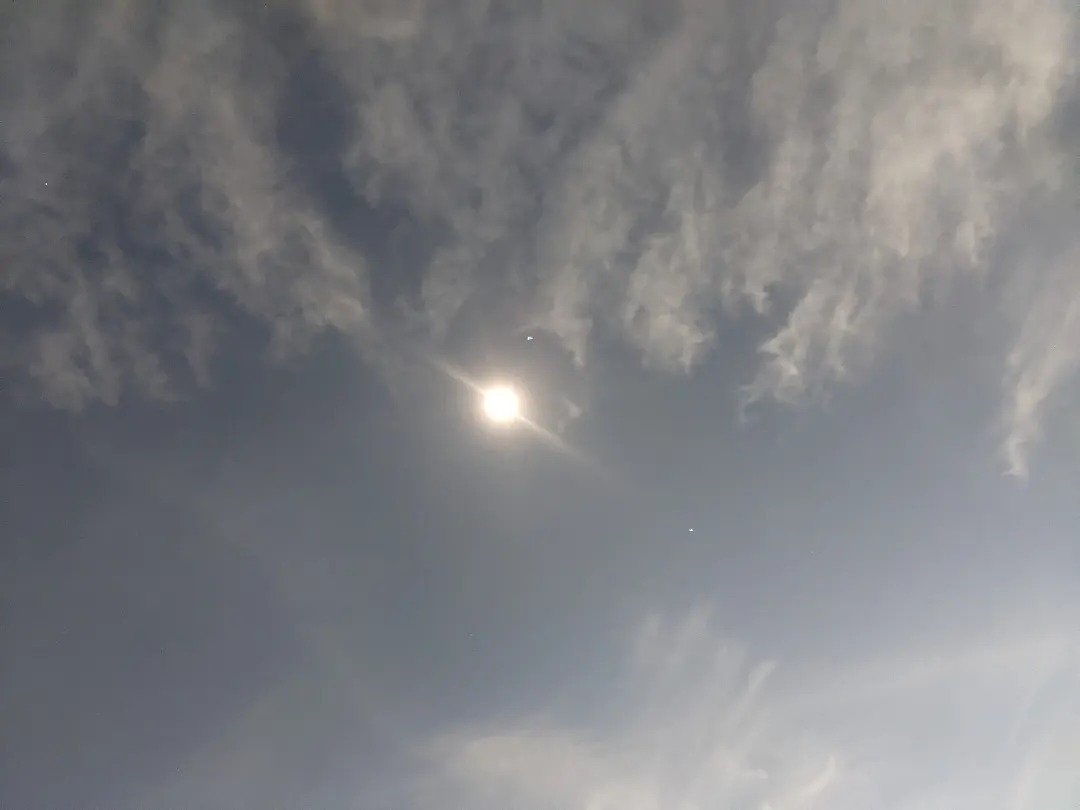
As the moon slowly covered the sun, the skies gradually dimmed. Around 10 minutes before the eclipse, the shadows from the leaves on trees became much sharper. I should have taken a “before” picture – the contrast with the blurry shadows earlier was striking. This was taken about two minutes before totality.

In the last 30 seconds before the eclipse, God once again dimmed the light switch and day transitioned to night. The planets came out, the sun’s ghostly corona appeared in all its glory, and all of us stared up in amazement.
This time, the corona appeared significantly more symmetrical than 2017. If you take a look at most images of the 2017 eclipse, you’ll see three “jets” shooting out from the main corona. This eclipse was far more symmetrical and looked a bit brighter as well. I’m not a photographer and didn’t get any super high-resolution shots, but here’s one from Lars Leber. You can see “Baily’s Beads” in this picture, which occur *just* before (or after) totality, with the sun’s photosphere peaking through valleys in the moon’s surface but being blocked by its peaks.
I did snag a pic towards the very end of the eclipse as the clouds were parting. This was taken shut a few seconds after totality. I have a low-resolution cell phone camera so the corona/diamond ring is smeared, but you can still see the planets come out. That’s Venus down and right to the sun, and Jupiter in the upper left-hand corner (credit to Karl Bonner for this tidbit, check out his weather blog here). I’m not sure what the spot just above the corona is but it is likely an airplane. Indeed, several commercial and government airplanes were flying along the path of totality, giving passengers a spectacular view of the eclipse and collecting valuable scientific data above the veil of high clouds.
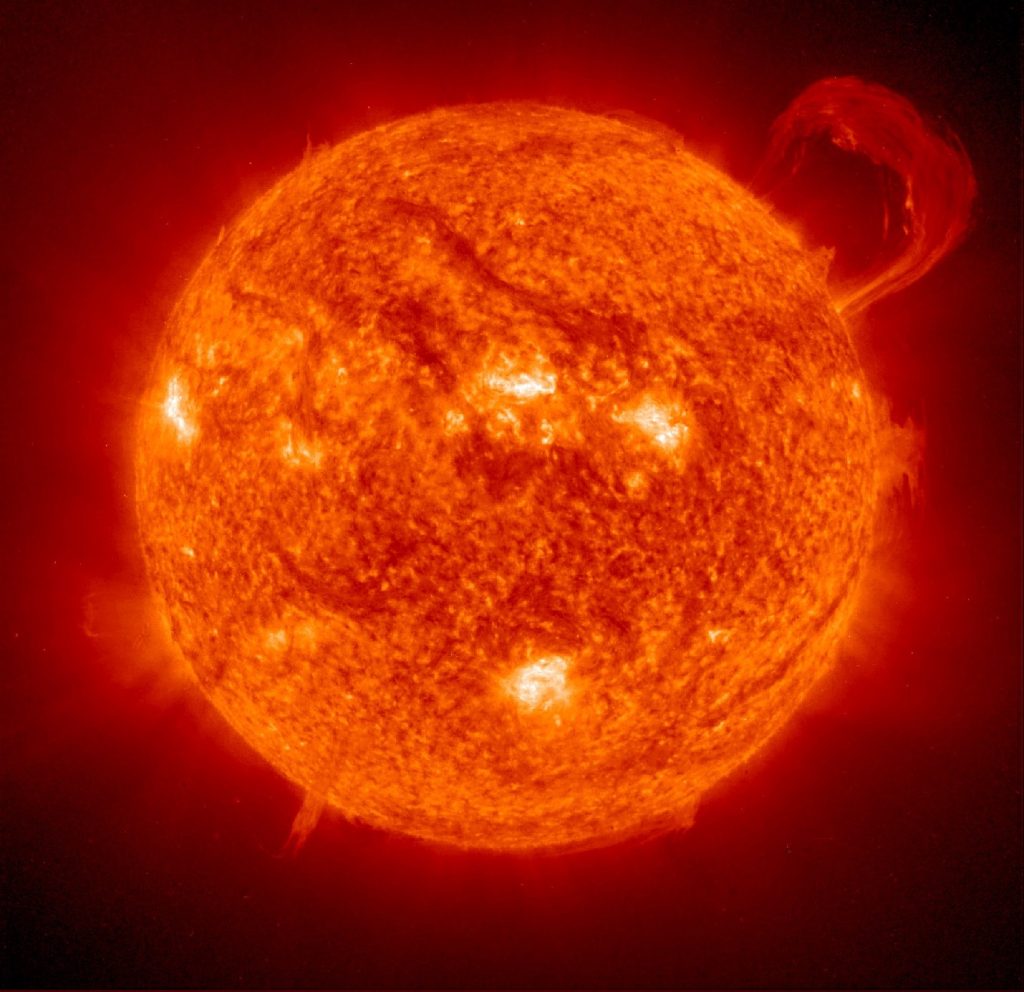
One of the most notable features of this eclipse were the solar prominences. Prominences are huge, stationary magnetic loops of plasma anchored to the sun’s photosphere (surface). The sun’s “activity,” as shown by the number of sunspots on the sun’s surface, occurs in ~12 year cycles, and the more active the sun, the brighter the corona and the more numerous the prominences.
Activity on the sun today may be low, with only C flares, but long-term solar activity is high! Today, we confirm that June's sunspot count surpassed the peak of the previous solar cycle, reaching its highest point in 21 years.
— EarthSky (@earthskyscience) July 4, 2023
Learn more: https://t.co/6Xd48jM0Nf
📸 NOAA. pic.twitter.com/bMFZKHHIsC
One of the largest prominences on record occurred in September 1999 and stretched 2.2 million miles into space. For reference, that’s over 775 times the diameter of the earth!
In 2017, the prominences were weakly visible, but this time, they were far more pronounced and were visible to the naked eye. I remember seeing one on the bottom right of the sun as I looked skyward in a calm, wondrous gaze. The eclipse photo above captures it, but my friend Garret Hartung, who was in Indiana at the time, captured an astonishing photo highlighting these prominences.
Totality in Richmond, Indiana. Look at those prominences 🥹 #Eclipse2024 pic.twitter.com/sRrbuiA0i9
— Garret Hartung (@HartungWx) April 8, 2024
He also captured a stunning pic of Baily’s Beads. You can really see the topography of the moon here. By the way, please follow Garret on Twitter if you haven’t already. He’s an avid storm chaser and regularly posts incredible stuff.
Bailey’s beads during the final few seconds before totality yesterday #Eclipse2024 pic.twitter.com/ARjz2GHYNR
— Garret Hartung (@HartungWx) April 9, 2024
All-in-all, it was a wonderful experience and well worth the trip. The next total solar eclipse will be on August 12, 2026 and will pass over the Arctic, Greenland, Iceland, Spain, and the Atlantic Ocean. For the Continental United States, you’ll have to wait until 2044, but another one will arrive right on its heels in 2045.